Raw sugar is cane sugar that has been crystallised at the mill but not refined: it keeps a thin film of molasses, so it is golden to brown, typically 97.8–99.5° polarisation and roughly ICUMSA 600–1,500 in colour. Refined white sugar has been melted, cleaned, decolourised and recrystallised, so it is at least 99.8% sucrose and ICUMSA 45 or lower. In the export trade, raw sugar is mostly an industrial feedstock shipped in bulk to refineries, while refined white sugar is the finished product that food and drink makers and distributors buy. This guide explains the differences that matter when you buy either one.
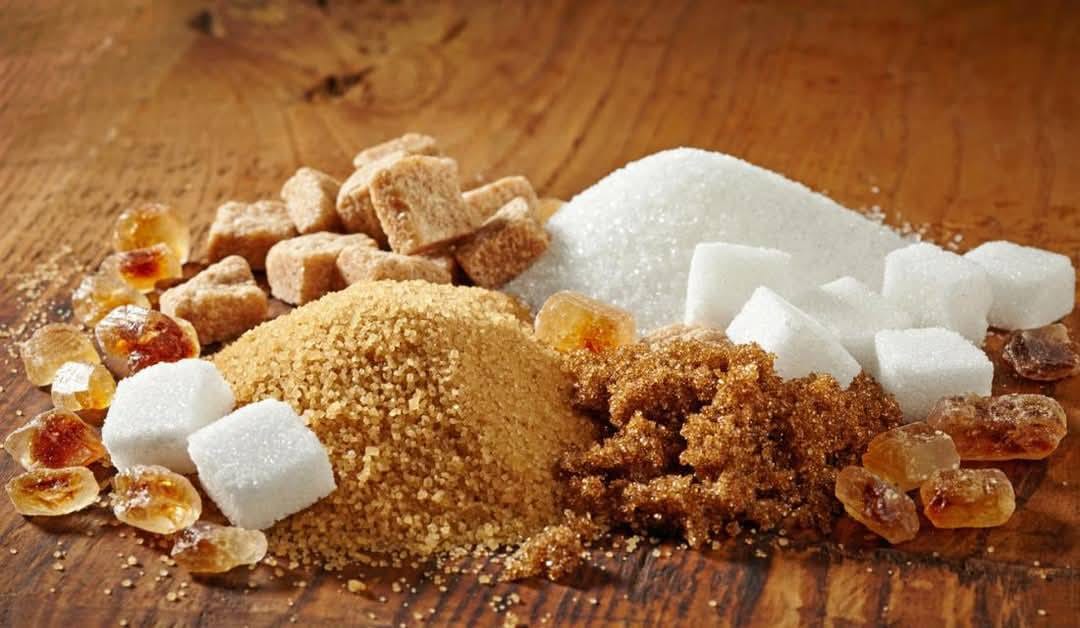
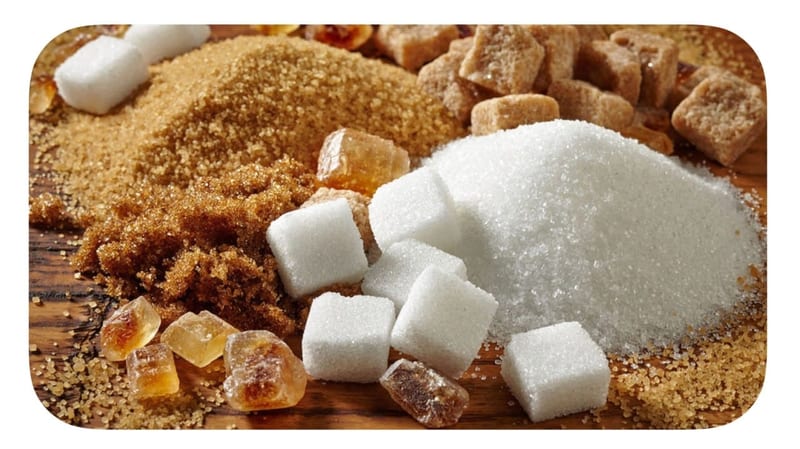
From left to right, the colour deepens as less molasses is removed: refined white, then progressively rawer sugars
Raw sugar vs refined white sugar at a glance
| Raw cane sugar (VHP type) | Refined white sugar (ICUMSA 45) | |
|---|---|---|
| Where it is made | At the cane mill (usina) | At a refinery, or a refinery attached to a mill |
| Colour (ICUMSA) | About 600–1,500 IU | 45 IU or lower |
| Sucrose / polarisation | Pol 99.3° minimum for VHP; 97.8–99.5° across raw grades | Sucrose ≥ 99.8% |
| Moisture | Higher, about 0.10–0.15% for VHP, up to 0.30% for other raws | ≤ 0.04% for ICUMSA 45 |
| Ash | Higher, carries molasses minerals | ≤ 0.04% |
| Main buyer | Destination refineries | Food, beverage, pharma, distributors |
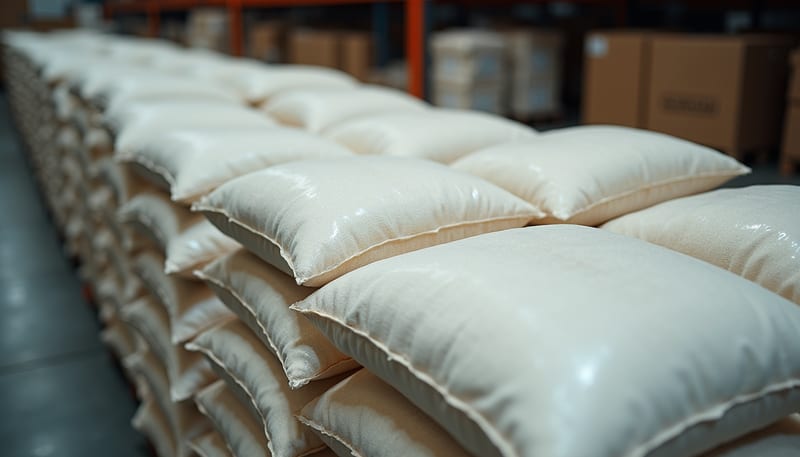
| How it ships | Mostly loose in bulk vessels | 50 kg bags or 1 t jumbo bags in containers; also bulk |
| Price benchmark | ICE Sugar No. 11 (raw) | ICE London No. 5 (white) |
| Eaten as delivered? | Not in most markets; it is refined first | Yes |
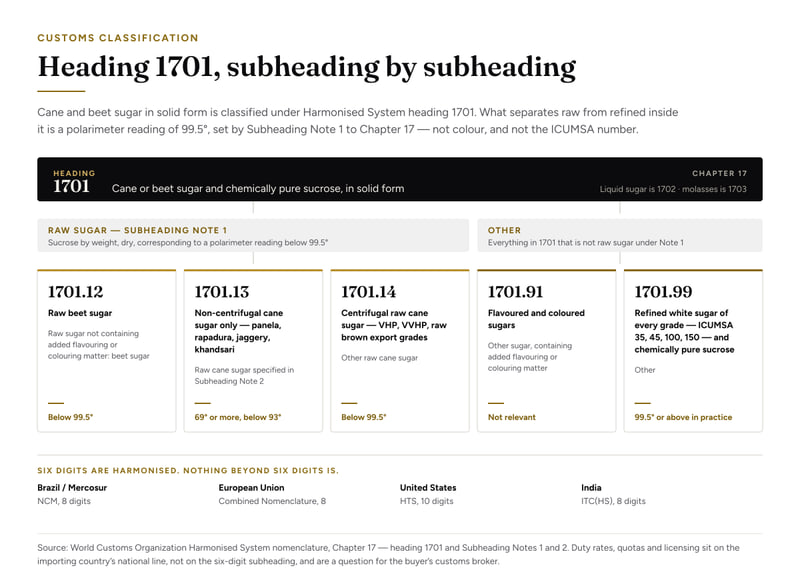
| HS subheading | 1701.14 (other raw cane sugar) | 1701.99 |
The specification limits in our product pages are the ones we quote against: see ICUMSA 45 and raw cane sugar ICUMSA 600–1200.
What raw sugar is
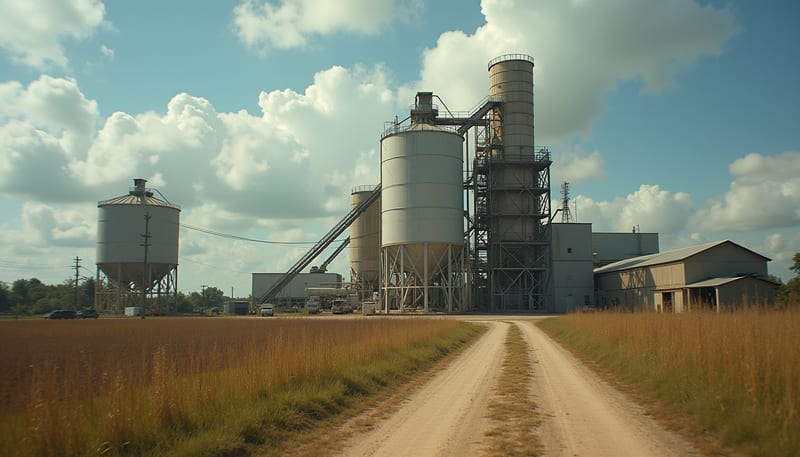
At a Brazilian mill, cane is crushed, the juice is clarified with lime and heat, evaporated to syrup and boiled in vacuum pans until sucrose crystals form. Centrifuges spin the crystals out of the surrounding molasses. If the mill stops there, the crystals still carry a thin coat of molasses: that is raw sugar.
Brazil's standard export raw sugar is VHP, very high polarisation. "Polarisation" (pol) is how the sucrose content is measured, with a polarimeter, and VHP sugar reads 99.3° or higher. It was developed so that refineries abroad receive a raw sugar that is easy and cheap to refine. Our explainer on VHP sugar covers the specification and contract terms in detail, including the slightly whiter VVHP.
Raw sugar is a commodity feedstock. Most of it travels in the holds of bulk carriers from Santos or Paranaguá to refineries in Asia, the Middle East and Africa, which turn it into white sugar for their own markets.
What refined white sugar is
Refining removes what raw sugar still carries. A refinery:
- Affines the raw sugar, washing off the outer molasses film with a warm syrup.
- Melts the crystals into a liquor.
- Clarifies the liquor, usually by carbonatation or phosphatation, to drop out fine solids.
- Decolourises it through activated carbon or ion-exchange resin.
- Recrystallises the clean liquor in vacuum pans, spins it, dries it and conditions it.
The result is the bright white, free-flowing crystal sold as ICUMSA 45 in the export trade, with ICUMSA 35 or lower for the most demanding beverage specifications. The whole sequence is set out step by step in sugar mill vs sugar refinery.
Between the two sit the mill whites or plantation whites (around ICUMSA 100–150), made at the mill by sulphitation without a full refining step. They are edible and cheaper than ICUMSA 45, but they are not the same thing. See ICUMSA 100 and the ICUMSA grade chart.
Cane sugar vs white sugar: a common confusion
"Cane sugar vs white sugar" is one of the most searched sugar questions, and it mixes two different things:
- Cane vs beet is about the plant the sugar came from.
- Raw vs white is about how far the sugar was refined.
White sugar can be made from cane or from beet, and once refined to ICUMSA 45 the two are chemically the same sucrose. Everything Brazil exports is cane sugar, in both raw and white forms. For the plant-level comparison, see beet sugar vs cane sugar.
Retail "raw cane sugar", turbinado and demerara are a third category: lightly processed cane sugars made for shoppers, with a controlled crystal size and flavour. They are not the bulk VHP raw sugar sold to refineries. Demerara vs muscovado explains those speciality sugars.
Is raw sugar healthier than white sugar?
Not in any meaningful way. Both are almost entirely sucrose and carry about the same energy, close to 4 kcal per gram. The molasses film on raw sugar adds trace amounts of minerals, but in quantities too small to matter in a normal diet. Choose between them on function, flavour, colour and cost, not on nutrition.
Which one should a buyer specify?
| Your business | Usual choice | Why |
|---|---|---|
| Sugar refinery | Raw VHP (ICUMSA 600–1,500) | Cheapest feedstock per unit of sucrose |
| Soft drinks and clear beverages | ICUMSA 45 or lower | No colour, odour or floc in the drink |
| Confectionery, dairy, bakery | ICUMSA 45 or ICUMSA 100 | Colour matters; budget decides |
| Distributor or repacker for retail | ICUMSA 45, sometimes ICUMSA 100–150 | Depends on what local shoppers expect |
| Rum, fermentation, animal feed, some baking | Raw or brown grades | Colour and flavour are acceptable or wanted |
Check your own import rules too. Several markets tax raw sugar for refining at a lower rate than white sugar, or allow only licensed refiners to import raw sugar. Our country guides for Indonesia, Nigeria and China show how different those rules are.
How the prices relate
Raw and white sugar have separate futures benchmarks. ICE Sugar No. 11 prices raw sugar, and ICE London No. 5 prices refined white sugar. The gap between them is called the white premium, and it is roughly what a refinery earns for turning raw into white. When the white premium is wide, refining is profitable and destination refineries buy more raw sugar; when it is narrow, importers tend to buy white sugar directly.
We do not publish prices, because they move every trading day. Sugar price today explains both benchmarks and how a physical quotation is built from them.
Shipping and storage differences
- Raw sugar ships mostly loose in bulk carriers, tens of thousands of tonnes at a time, and is stored in large covered warehouses at the terminal. Its higher moisture makes it more prone to caking and microbial deterioration if it gets wet.
- Refined sugar usually ships bagged, 50 kg or 1 t jumbo bags, in 20 ft or 40 ft containers, which suits buyers who need one container rather than a ship. See sugar packaging for export and sugar storage and shelf life.
Buying raw or refined sugar from Brazil
We export both: raw cane sugar at ICUMSA 600–1,200 and refined grades from ICUMSA 35 to ICUMSA 100, FOB Santos or Paranaguá, or CFR/CIF to your port. Tell us the grade, the tonnage, the packaging and the destination, and we confirm the specification in writing before we quote. Request a quotation.
Frequently asked questions
What is the main difference between raw sugar and refined sugar? Raw sugar keeps a thin film of molasses and is around ICUMSA 600–1,500 in colour; refined sugar has had the molasses and colour removed and is at least 99.8% sucrose at ICUMSA 45 or lower.
Is raw sugar the same as brown sugar? No. Bulk raw sugar is a refinery feedstock. Retail brown sugar is either a speciality cane sugar such as demerara or refined sugar with molasses added back.
Can you eat VHP raw sugar? It is cane sugar, but in most markets VHP raw sugar is sold for refining, not for direct consumption, and it is not packed or specified as a food ingredient.
Is cane sugar the same as white sugar? White sugar can be made from cane or beet. Refined white cane sugar and refined white beet sugar are both almost pure sucrose.
Why is raw sugar cheaper than white sugar? Because it has not been refined. The difference between the two, the white premium, roughly covers the cost and margin of refining.
Which HS code applies to raw cane sugar? Centrifugal raw cane sugar such as VHP is classified under HS 1701.14; refined white sugar under 1701.99. See sugar HS code 1701.