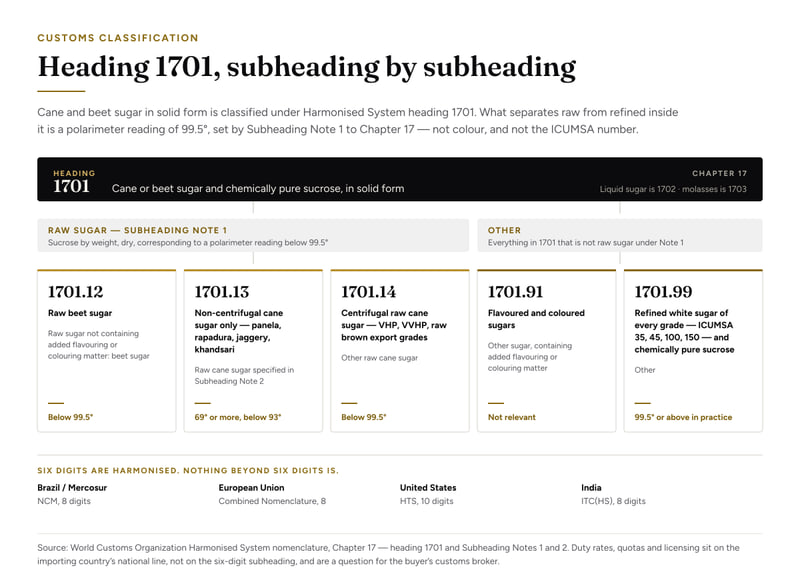
Heading 1701 divides at a polarimeter reading of 99.5 degrees, not at a colour figure.
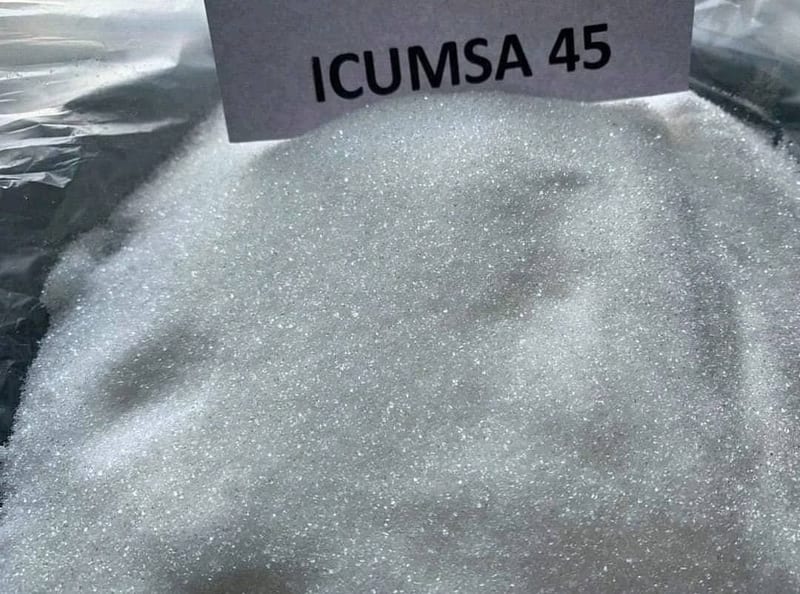
Cane and beet sugar in solid form is classified under Harmonised System heading 1701. Refined white sugar — ICUMSA 35, 45, 100 and 150 — falls under subheading 1701.99. Raw centrifugal cane sugar, including Brazilian VHP and the raw brown grades, falls under 1701.14. What separates the two is not the colour of the sugar and not the ICUMSA number: it is a polarimeter reading of 99.5 degrees, set by Subheading Note 1 to Chapter 17.
Almost every classification argument we see on a buyer's documents comes from not knowing that one threshold. This page sets out the structure of heading 1701, the two Subheading Notes that govern it, which line each grade we export falls under, and the points where a mismatch between the declared code and the certificate of analysis will stop a container.
What the Harmonised System standardises, and where it stops
The Harmonised Commodity Description and Coding System is maintained by the World Customs Organization and is used by the large majority of the world's customs administrations as the basis of their tariffs. It is standardised to six digits: chapter (two digits), heading (four), subheading (six). Those six digits mean the same thing in Santos, Jebel Ali, Nhava Sheva and Rotterdam.
Nothing beyond six digits is harmonised, and neither are duty rates. Each country extends the nomenclature to its own length — Brazil and the rest of Mercosur to eight digits as the NCM, the European Union to eight as the Combined Nomenclature, the United States to ten in the HTS, India to eight in the ITC(HS) — and attaches its own rates, quotas and licensing to those national lines.
So there are two separate questions, and they get confused constantly:
- What is this sugar? Answered at six digits, identically everywhere, from the physical characteristics of the goods.
- What will it cost to import? Answered at the national line, from the importing country's tariff, its quota arrangements and the origin of the cargo.
A supplier can answer the first question. Only the buyer's customs broker can answer the second.
Chapter 17 at a glance
| Heading | Covers | In practice |
|---|---|---|
| 1701 | Cane or beet sugar and chemically pure sucrose, in solid form | Everything in the physical sugar trade: refined white, crystal, raw, VHP, brown |
| 1702 | Other sugars, including chemically pure lactose, maltose, glucose and fructose; sugar syrups; artificial honey; caramel | Liquid sucrose, invert syrup, glucose syrup, caramel colour |
| 1703 | Molasses resulting from the extraction or refining of sugar | Cane molasses (1703.10) and other molasses (1703.90) |
| 1704 | Sugar confectionery not containing cocoa | Finished confectionery, not an ingredient sugar |
Two consequences are worth stating because they catch people out. Sugar in liquid form is not in 1701 at all — liquid sucrose and invert syrups are classified in 1702, typically 1702.90. And molasses is 1703, a separate heading, even though it leaves the same mill on the same day as the sugar.
The threshold that separates raw from refined is 99.5°, not colour
Subheading Note 1 to Chapter 17 is the operative text. For the purposes of subheadings 1701.12, 1701.13 and 1701.14, raw sugar means sugar whose content of sucrose by weight, in the dry state, corresponds to a polarimeter reading of less than 99.5°.
Read that carefully, because it says something the trade routinely gets wrong. The dividing line in the nomenclature is polarisation — the sucrose content determined polarimetrically — and not colour. The ICUMSA figure that names the grade on your contract is a colour measurement, taken by a completely different method, and it does not decide the subheading. The ICUMSA colour scale and what the number actually measures is worth reading alongside this page precisely because the two parameters move independently: a sugar can be very pure and very dark at the same time, which is exactly what high-polarisation raw sugar is.
The practical rule: the polarisation stated on the certificate of analysis for the lot decides whether the cargo is raw or not for customs purposes. If your contract specifies a colour and is silent on polarisation, you have a specification that cannot be classified.
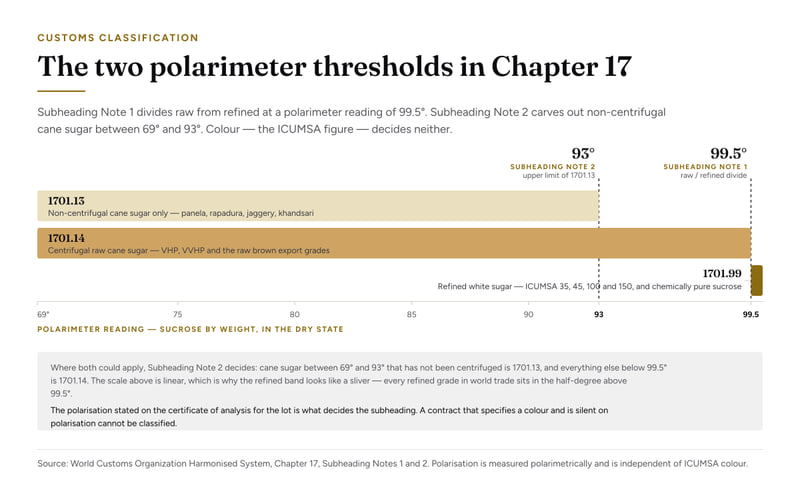
The two polarimeter thresholds in Subheading Notes 1 and 2 to Chapter 17, and the subheadings they divide.
Heading 1701, subheading by subheading
| Subheading | Nomenclature text, in brief | What it is in the trade | Polarisation |
|---|---|---|---|
| 1701.12 | Raw sugar not containing added flavouring or colouring matter: beet sugar | Raw beet sugar | Below 99.5° |
| 1701.13 | Raw cane sugar specified in Subheading Note 2 to the chapter | Non-centrifugal cane sugar only: panela, rapadura, jaggery, khandsari | 69° or more but below 93° |
| 1701.14 | Other raw cane sugar | Centrifugal raw cane sugar: VHP, VVHP, raw brown export grades | Below 99.5° |
| 1701.91 | Other sugar, containing added flavouring or colouring matter | Flavoured and coloured sugars | Not relevant |
| 1701.99 | Other | Refined white sugar of every refined grade, and chemically pure sucrose | 99.5° or above in practice |
The structure is a two-branch split. The first branch, the one-dash "raw sugar not containing added flavouring or colouring matter", holds 1701.12, 1701.13 and 1701.14. The second branch, "other", holds 1701.91 and 1701.99. Anything that is neither raw under Subheading Note 1 nor flavoured or coloured lands in 1701.99 — which is why 1701.99 is the line under which the overwhelming majority of Brazilian refined white sugar is exported and imported.
Why 1701.13 is not the raw cane sugar line
This is the single most common misclassification in the sugar trade, and it is worth one section on its own, because 1701.13 looks like the obvious home for raw cane sugar and is not.
Subheading Note 2 to Chapter 17 restricts 1701.13 to cane sugar obtained without centrifugation, whose sucrose content by weight in the dry state corresponds to a polarimeter reading of 69° or more but less than 93°, and which contains only natural anhedral microcrystals of irregular shape, not visible to the naked eye, surrounded by residues of molasses and other constituents of sugar cane.
That is a precise description of non-centrifugal cane sugar: Brazilian rapadura, Latin American panela, South Asian jaggery and khandsari. It is a different product made by a different process, and it is nowhere near the export grades.
Brazilian raw export sugar is centrifugal and is traded at polarisation far above 93°. VHP raw cane sugar — the name is an abbreviation of very high polarisation — is contracted below the 99.5° line, which is what keeps it in the raw branch, while being substantially purer than the 96-degree average polarisation raw cane sugar that is deliverable against the ICE No. 11 contract. So Brazilian raw cane sugar is 1701.14, never 1701.13.
Which subheading each Brazilian grade falls under
| Grade | Colour | Subheading | What decides it |
|---|---|---|---|
| Refined white ICUMSA 45 | 45 ICUMSA max | 1701.99 | Polarisation above 99.5°, stated on the certificate of analysis |
| Refined white ICUMSA 35 | 35 ICUMSA max | 1701.99 | As above |
| Crystal and plantation white, ICUMSA 100–150 | 100–150 ICUMSA | 1701.99 where the lot polarises at 99.5° or above | A boundary case: a crystal lot contracted below 99.5° is raw in the nomenclature and belongs in 1701.14 |
| VHP and raw brown, ICUMSA 600–1200 | 600–1200 RBU | 1701.14 | Centrifugal cane sugar below 99.5° |
| Non-centrifugal sugars (rapadura, panela) | Not graded in ICUMSA units | 1701.13 | Non-centrifugal process, 69°–93° pol. Listed for completeness; we do not export this product |
| Liquid sucrose, invert syrup | Not applicable | 1702 | Not solid sugar, so outside heading 1701 entirely |
The crystal and plantation-white row is the one to watch. A sugar sold as "ICUMSA 150" says nothing about which side of the 99.5° line it sits on, and the two sides are different subheadings with different duty treatment in most tariffs. Settle polarisation in the contract, not after the certificate of analysis arrives.
Beyond six digits: Brazil's NCM and your own tariff line
On the Brazilian export side, the declaration is made on the eight-digit NCM, the Mercosur Common Nomenclature, which is the HS extended by two digits. Raw cane sugar is declared under NCM 1701.14.00 and refined white under NCM 1701.99.00; Brazilian export statistics are published against those NCM codes in Comex Stat, the official trade statistics portal of the Ministry of Development, Industry, Trade and Services. Confirm the current line in the published NCM table before a declaration — Mercosur revises it.
On the import side, the operative code is in your tariff, and sugar is one of the most heavily managed agricultural lines in almost every schedule. The national line is where tariff-rate quotas, in-quota and out-of-quota rates, import licensing and safeguard measures live. Two buyers importing identical ICUMSA 45 from the same mill into two countries will be looking at two different national codes with two different rates, both of them extensions of 1701.99.
What a serious supplier gives you is the six-digit subheading and the specification that justifies it. What your broker gives you is the national line and the rate. Anybody quoting you a landed duty figure from the other side of the ocean is guessing.
Where the code appears in the documents, and what has to match
The subheading is not one entry on one form. It propagates across the document set, and the documents have to agree with each other:
- the commercial invoice and packing list;
- the bill of lading cargo description;
- the certificate of origin, which states the heading or subheading of the goods it certifies;
- the Brazilian export declaration and your import declaration;
- and frequently the documentary letter of credit itself, where the description of goods is part of the terms the bank checks.
Three mismatches cause nearly all of the trouble:
- The declared subheading says refined (1701.99) while the certificate of analysis shows polarisation below 99.5°. Customs reads the certificate, not the invoice heading.
- The certificate of origin names a different heading from the invoice. Under most preferential arrangements that is enough to lose the preference on that shipment.
- The L/C description of goods does not match the invoice wording, including the code. A discrepancy of this kind delays payment on a cargo that is already afloat, and it costs far more than any duty difference it was supposed to avoid.
All three are avoidable at the contract stage, which is the cheapest possible point to fix them. What each trade document proves, and which ones prove nothing, is worth reading before the contract is drafted rather than after. Agree the subheading, require the certificate of analysis to state polarisation with the method used, and make the L/C description of goods a copy of the invoice description. Our own purchase sequence — how to buy sugar from Brazil, step by step — puts the specification and documentation conversation before the quotation for this reason.
Classification sets the line. Origin sets the duty.
Classification and origin are different questions answered by different documents, and confusing them is expensive.
The subheading identifies the goods. Origin determines which column of the importing tariff applies to that subheading: most-favoured-nation, preferential, in-quota, or out-of-quota. In several of the markets that buy Brazilian sugar the preferential certificate of origin is a line item in the buyer's landed cost rather than a formality, and for Arab-League destinations in particular the preferential certificate is what determines the tariff actually paid.
In Brazil, certificates of origin are issued by entities accredited by SECEX, the Foreign Trade Secretariat, and since Portaria SECEX nº 373/2024 exporter self-certification through a declaration of origin is also available under certain agreements, with the exporter carrying the responsibility for the statement. Either route produces a document your customs authority will accept; which one applies depends on the agreement between Brazil and your market.
Price works the same way — a quoted figure is a function of the market, the grade and the terms, not of the tariff. How a price per tonne is actually built sets out the ICE No. 11 basis, the white premium and the Incoterm effect, none of which has anything to do with your HS line.
What to send with an enquiry so the paperwork is right first time
Send these six items and the specification, the classification and the quotation can all be settled in one exchange:
- the grade, with the ICUMSA colour ceiling and the polarisation minimum you need;
- the tonnage, and whether it is a single shipment or a programme;
- the destination port;
- the Incoterm you want the price on;
- the packaging — 50 kg bags, 1,000 kg jumbo bags, or bulk;
- the shipment window — and if timing matters to you, Brazil's two cane harvest calendars explain what moves it — together with the national tariff line your broker expects to declare.
On our side, minimum order quantity, Incoterms offered, port of loading, lead time, payment terms and packaging are confirmed on quotation, because each moves with destination and volume. The specification figures, polarisation included, are stated on the certificate of analysis issued for the lot being shipped. Send us those six items and the first reply can be a real quotation rather than a request for more information.
Classification last reviewed 19 October 2026.
Sources
-
WCO Harmonised System Nomenclature, Chapter 17 — the authority for heading 1701 and for Subheading Notes 1 and 2 quoted above. The Chapter 17 text, including both Subheading Notes, is reproduced verbatim in national tariffs: see for example the Canada Border Services Agency Customs Tariff, Chapter 17, and the Swiss Federal Office for Customs and Border Security chapter notes.
-
NCM / Mercosur Common External Tariff and Comex Stat, Brazilian Ministry of Development, Industry, Trade and Services — the eight-digit Brazilian lines (1701.14.00, 1701.99.00) and the official export statistics published against them.
-
Portaria SECEX nº 373/2024 — the current rules on certificates of origin issued by accredited entities and on exporter self-certification through a declaration of origin.
-
ICE Futures No. 11 contract specification — the raw cane centrifugal sugar contract, 96 degrees average polarisation, which is the reference point for what "raw" means commercially as distinct from what it means in the nomenclature.
-
ICUMSA Methods Book — the reference methods behind the colour figure, including GS2/3-10 for the colour of white sugar, summarised on our sugar grades and ICUMSA colour page.
Where this page states a figure for a grade we supply, that figure is certified per lot on the certificate of analysis. Where it states the nomenclature, the WCO text and your own national tariff are the authorities and should be consulted in preference to any secondary source, including this one.