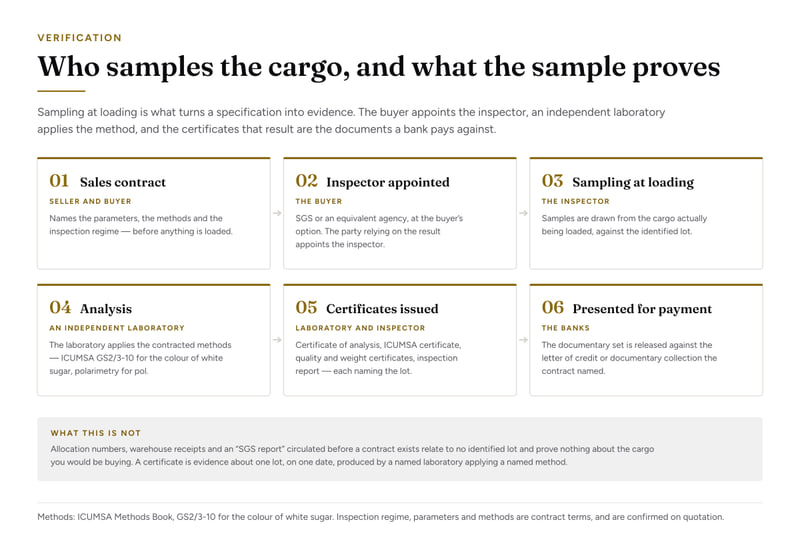
Sampling at loading is what turns a specification into evidence. The buyer appoints the inspector.
An SCO, FCO, ICPO, LOI, BCL and "proof of product" are not instruments of international trade. None of them is defined in any ICC rule, none is recognised by UCP 600, and no bank will act on one. They are broker-chain correspondence. A genuine bulk sugar purchase runs on a short, boring sequence instead: enquiry, quotation, sales contract, payment instrument, shipment, documents. If a counterparty wants an ICPO carrying your company and banking details before it will give you a price, you are not in a sale — you are in a chain.
This page defines each of those terms accurately, sets out the document set a real cargo actually produces, and gives the verification steps a buyer can complete on a Brazilian supplier in about twenty minutes using public records.
The vocabulary, defined
| Term | What it stands for | What it actually is |
|---|---|---|
| SCO | Soft Corporate Offer | A non-binding indication of a seller's willingness to supply. No price validity, no commitment, no legal effect. Often circulated by an intermediary who has not spoken to the producer. |
| FCO | Full Corporate Offer | Presented as the binding version of an SCO. It is not a recognised instrument either; whether it binds anyone depends entirely on its own wording and on who signed it. |
| ICPO | Irrevocable Corporate Purchase Order | A document a buyer is asked to issue — on letterhead, usually with company registration and banking details — before receiving a price. Nothing about it is irrevocable. Its practical function is to give the intermediary something to shop around. |
| LOI | Letter of Intent | A statement of interest. In commodity broker chains it serves the same circulation purpose as the ICPO. |
| BCL | Bank Comfort Letter | A letter from a buyer's bank indicating the buyer is known to it. It places no obligation on the bank and commits no funds, so it proves nothing about ability to pay — which is the job a documentary letter of credit actually does. |
| POP | Proof of Product | Documents offered as evidence that the cargo exists — allocation numbers, warehouse receipts, "SGS reports". Unverifiable as a category, and the version that arrives before a contract usually relates to no specific lot. |
| NCNDA / IMFPA | Non-Circumvention Non-Disclosure Agreement / Irrevocable Master Fee Protection Agreement | Commission-protection agreements between intermediaries. Legitimate in principle; a tell when they circulate before any specification has been agreed, because they protect a fee on a cargo nobody has yet identified. |
Two of these terms are worth separating from the rest. A letter of intent and a commission agreement are ordinary commercial documents with ordinary uses. The problem is never the document — it is the sequence. Any request that puts your company details, your bank's letterhead or a signed fee agreement before a specification and a price has inverted the order in which a sale is built.
Why this paperwork exists
Physical sugar is sold by a small number of mills, refineries and trading companies, and bought by refiners, bottlers, repackers, distributors and state buyers. Between those two groups sits a large population of intermediaries, many of whom have no cargo, no contract with a producer and no ability to perform.
It is worth knowing who the real counterparties in this trade are before you start — mills, refineries and a small number of trading companies, as set out in our survey of Brazilian sugar suppliers and exporters. The intermediary population needs two things to operate: a document that makes a buyer look committed (the ICPO), and a document that makes a seller look real (the FCO). Both circulate by email, both can be produced by anyone with a word processor, and neither requires the author to have access to a single tonne of sugar. The paperwork is the product.
The cost to a buyer is rarely a lost deposit. It is six weeks of correspondence, a specification that keeps changing, a price that moves once you are committed, and a cargo that never had a vessel. Our companion page on how to choose and verify a bulk sugar supplier covers vendor selection more broadly; this page is about the documents themselves.
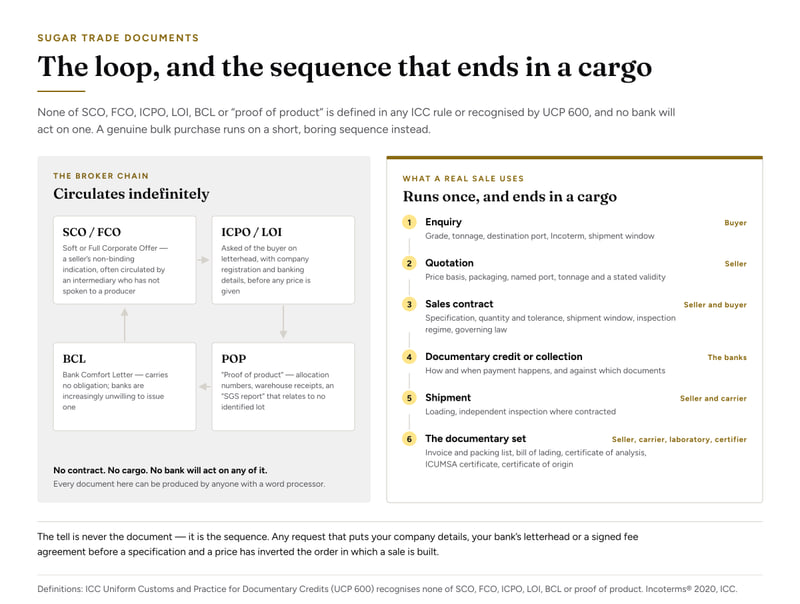
The loop on the left can run indefinitely. The sequence on the right ends in a cargo.
What a genuine sugar sale actually uses
| Document | Issued by | What it establishes |
|---|---|---|
| Quotation | Seller | Price basis, grade, Incoterm and named port, packaging, tonnage, validity period |
| Sales contract | Seller and buyer | The specification, the terms, the shipment window, the inspection regime, the governing law |
| Documentary letter of credit or documentary collection | The banks | How and when payment happens, and against which documents |
| Commercial invoice and packing list | Seller | What is being shipped, at what price, in what packing |
| Bill of lading | Carrier | Receipt for the cargo, evidence of the contract of carriage, and — if negotiable — title |
| Certificate of analysis | Mill or independent laboratory | The measured values for the contracted parameters, for the identified lot |
| ICUMSA certificate | An independent laboratory applying an ICUMSA method | The measured colour of a specific lot, in ICUMSA units |
| Certificate of origin | An entity accredited by SECEX, or the exporter where self-certification applies | Brazilian origin, which is what determines the tariff column in many markets |
| Weight and quality certificate | Inspection company | Quantity and condition as found at loading |
| Pre-shipment inspection certificate | Inspection company appointed by the buyer | Independent verification before the cargo sails |
| Phytosanitary certificate | MAPA, Brazil's agriculture ministry | Required by some destinations for some grades; confirm against your own import rules |
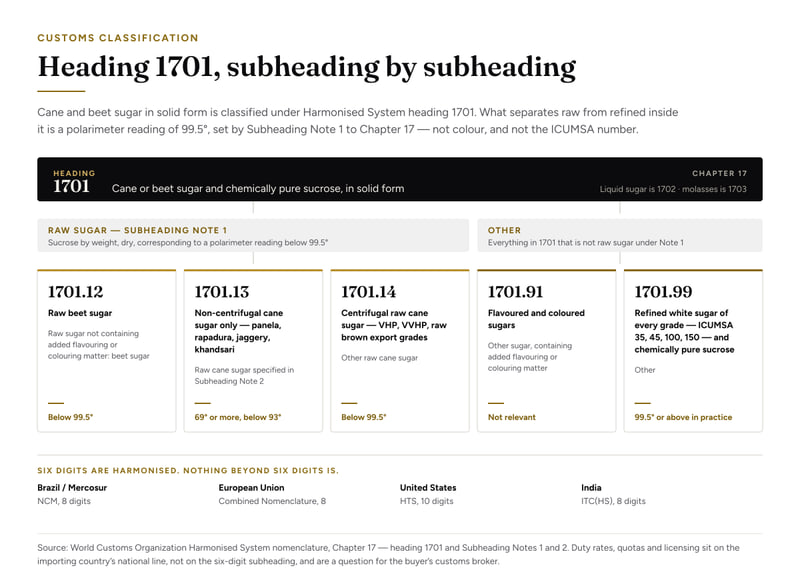
One detail inside that set repays attention: the heading declared on the invoice, the certificate of origin and the customs declarations has to be the same heading, and for sugar it turns on polarisation rather than colour — the sugar HS code and heading 1701 sets out why. Every document in that table is issued by an identifiable party who can be contacted and whose issuance can be checked. That is the whole difference between this list and the previous one.
Two corrections that save time. There is no such thing as an ICUMSA-certified supplier: ICUMSA publishes analytical methods and its membership is national committees for sugar analysis, not companies, so an ICUMSA certificate is a laboratory's report applying an ICUMSA method — the point is set out in full on our ICUMSA and sugar grades page. And a product datasheet is not a certificate of analysis: the datasheet describes a grade, the certificate reports measured values for the lot you are buying.
Eight red flags, in the order you will meet them
- An offer with no named loading port, no packaging and no validity date. A seller who can load knows where and in what. One who cannot is forwarding somebody else's email.
- A request for an ICPO before a price. The price should come first. It costs the seller nothing to issue and tells you whether to continue.
- "Send a BCL and we will release POP." A bank comfort letter before a specification has been agreed is a filter for inexperience, not a credit check.
- Proof of product you have to pay to see. Allocation numbers and warehouse receipts that cannot be traced to a named lot in a named store prove nothing.
- A price well under the market. A refined white quotation materially below the ICE No. 11 basis plus the prevailing white premium is not a bargain. Refined sugar is a traded commodity with a public reference price; nobody sells it at a discount to the market by email to a stranger. How a price per tonne is built gives you the arithmetic to test an offer in two minutes.
- An NCNDA or IMFPA circulating before a specification. Fee protection on an unidentified cargo.
- A counterparty who cannot name the mill, the region or the port. Brazilian export sugar comes out of identifiable regions and loads at identifiable ports — in our case São Paulo, Minas Gerais and Goiás, loading at Santos or Paranaguá. Vagueness here is not commercial discretion.
- A payment route that is not a bank instrument. Advance wire transfers to a personal account, or to an account in a third country unrelated to the exporter, in place of a documentary letter of credit or documentary collection.
How to verify a Brazilian sugar supplier in twenty minutes
Everything below is public, free and usable before you reply to an offer.
1. Get the CNPJ, then look it up. Every Brazilian legal entity has a 14-digit CNPJ. The Receita Federal publishes a free lookup — Emissão de Comprovante de Inscrição e de Situação Cadastral — which returns the registration certificate for that number: legal name, trade name, registered address, date of registration, share capital, the registered activity codes, the partners or administrators, and the cadastral status. Status reads ativa, suspensa, inapta, baixada or nula. Anything other than ativa is a conversation to have before anything else. Note what the lookup does not show: it is a registration record, not a credit or tax-clearance check.
2. Read the activity codes, not just the status. The certificate lists CNAE codes for the company's registered activities. A company offering to export sugar should carry wholesale trade or export activity consistent with that. A registration whose activities have nothing to do with food or commodity trade is a flag.
3. Check the name on the CNPJ against the name on the offer. Not the trade name — the razão social. A mismatch between the entity on the registration record, the entity on the letterhead and the entity named as beneficiary on the payment instrument is the pattern that matters most, and it is visible for free.
4. Ask who issues the certificate of origin. In Brazil, certificates of origin are issued by entities accredited by SECEX, the Foreign Trade Secretariat, and since Portaria SECEX nº 373/2024 exporter self-certification through a declaration of origin is also available under certain agreements. A supplier who exports knows which route applies to your market. One who does not has not exported.
5. Appoint your own inspector. SGS, Intertek, Bureau Veritas and Control Union all operate in Brazil. The protection is not the brand name on the certificate — it is that you appointed and instructed the inspector, and that the mandate is written into the contract rather than offered as a favour. A seller who resists buyer-appointed inspection is telling you something.
6. Test the quotation against the market. Convert the ICE No. 11 price to US dollars per tonne, add the white premium for a refined grade, and see whether the offer is in the same universe. This one step disposes of a large share of fraudulent offers without any correspondence at all.
7. Then ask for the boring things. Grade and full specification, Incoterm and named port written the way the Incoterms rules write it, packaging and net weights, the tonnage the price applies to, the validity period, the payment mechanism, and the document list. Our page on how to buy sugar from Brazil sets out that sequence from the buyer's side.
What a certificate of analysis has to state
A certificate of analysis is lot-specific and dated, and these are the elements that make it usable rather than decorative:
- the issuing laboratory or mill, identifiable and contactable;
- the lot or shipment identification, and the marks that tie it to the cargo you are buying;
- the date of sampling and the date of analysis;
- each contracted parameter with its measured value, its unit, and the method used — colour in ICUMSA units with the method named (ICUMSA Method GS2/3-10 is the reference method for the colour of white sugar in solution, read at 420 nm after filtration at pH 7.0), polarisation by polarimeter, moisture by loss on drying, ash as conductivity ash, granulation by sieve analysis, and sulphur dioxide where contracted;
- a signature and a date.
A value without a method is not a result. Two laboratories reporting "colour 45" by different methods have not agreed on anything, and a reflectance figure in RBU and a solution-colour figure in ICUMSA units are not interchangeable at all.
What a pre-shipment inspection certificate has to state
Pre-shipment inspection is the one step that converts a specification into evidence, and a certificate that omits any of the following is weaker than it looks:
- the inspection company, the party who instructed it, and the sampling standard applied;
- where and when sampling took place — warehouse, at stuffing, or alongside;
- the lot, the marks, the number of bags and the net and gross weights found, not the weights declared;
- the parameters tested, each with its method, matching the contract specification line for line;
- the container and seal numbers for a containerised cargo, so the sealed units can be tied back to the sampled lot;
- the condition of the packing, which for 50 kg polypropylene bags and 1,000 kg jumbo bags is a real finding and not a formality;
- a statement of whether the certificate is final at loading, which is a contract question the inspection mandate must answer.
Specify in the contract who pays, who appoints, and whether the certificate is final — and specify it before shipment, because afterwards it is a dispute rather than a term.
How we quote, and what we will not sign
So that this page is not advice we exempt ourselves from, here is our own practice, stated plainly.
We are an export trading company, not a mill. We buy from Brazilian mills — in São Paulo, Minas Gerais and Goiás — and we sell FOB, CFR and CIF under Incoterms 2020, loading at Santos or Paranaguá. Our specification and terms of supply for refined white ICUMSA 45, the grade most of these enquiries concern, are published in full, including the lines that read confirmed on quotation.
We quote against the market on the day of the enquiry: the ICE No. 11 basis plus the white premium for refined grades, adjusted for grade, Incoterm, packaging and tonnage, with a stated validity window. We do not publish a price per tonne, because any figure left on a web page is wrong within days. We do not ask for an ICPO, a BCL or a letter of intent before quoting — send a grade, a tonnage, a destination port, an Incoterm, packaging and a shipment window and you get a price. Minimum order quantity, lead time and payment terms are confirmed on quotation, because each moves with destination and volume, and specification figures are stated on the certificate of analysis for the lot shipped. Independent inspection by SGS or an equivalent agency is available at the buyer's option, on request — the appointment is yours.
What we will not do: issue a full corporate offer naming a cargo we have not secured, accept an advance wire in place of a documentary instrument, or sign a fee agreement on a transaction that has no agreed specification. If an intermediary has told you otherwise about any Brazilian supplier, including this one, the CNPJ lookup in section one will settle it faster than the correspondence will.
Ready to test us against the checklist above? Send the six items and compare the reply with what this page says a serious quotation contains.
Document practice last reviewed 19 October 2026.
Sources
-
ICC Uniform Customs and Practice for Documentary Credits (UCP 600) and Incoterms 2020, International Chamber of Commerce — the rule sets that do govern documentary payment and delivery terms, and in which no SCO, FCO, ICPO, BCL or POP appears.
-
Receita Federal do Brasil — Emissão de Comprovante de Inscrição e de Situação Cadastral, the free public CNPJ registration lookup, and the cadastral status values it reports.
-
Portaria SECEX nº 373/2024, Secretaria de Comércio Exterior — the current rules on certificates of origin issued by accredited entities and on exporter self-certification through a declaration of origin.
-
ICUMSA Methods Book — the reference methods for sugar analysis, including GS2/3-10 for the colour of white sugar in solution; summarised on our sugar grades and ICUMSA colour page.
-
ICE Futures — the No. 11 raw sugar and No. 5 white sugar contracts, the public reference prices against which any physical offer can be tested.
Where this page describes our own practice it is a statement about this business. Where it describes the rules — origin certification, documentary credits, analytical methods — the issuing bodies above are the authorities and should be consulted in preference to any secondary source, including this one.