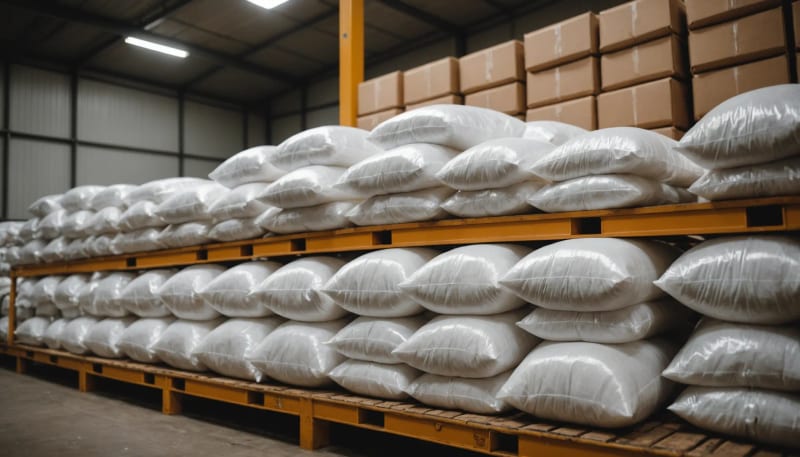
White granulated sugar is the most widely traded form of refined sucrose in the world. It is the sugar that fills retail bags, that food manufacturers formulate against, that soft-drink bottlers dissolve into syrup, and that arrives in twenty-foot containers at ports from Jeddah to Jakarta. Brazil is its largest exporter by a wide margin, shipping roughly 27 million tonnes of sugar a year, a substantial share of it as white refined grades. Yet the term "white granulated sugar" covers several distinct specifications, distinguished by the ICUMSA colour figure that separates a premium refined lot from a standard white one, and by the polarisation, moisture and ash readings that define what is inside the bag.
This page sets out what white granulated sugar is, how it compares with raw and brown sugar, which ICUMSA grades define the white category, what the specification lines mean in practice, how the sugar is produced, and what a bulk buyer needs to specify when purchasing it from Brazil.
What white granulated sugar actually is
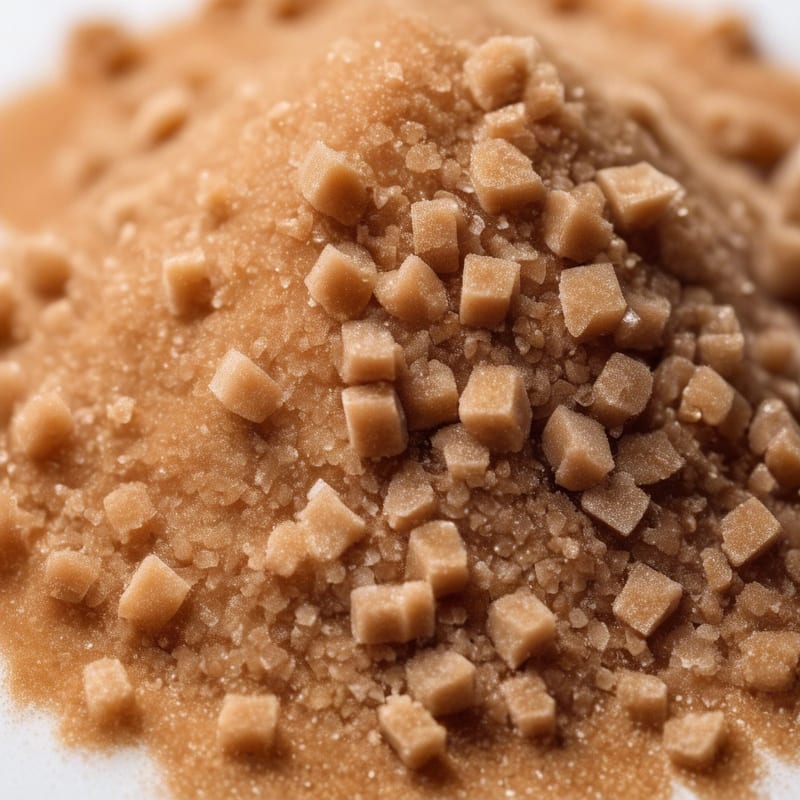
White granulated sugar is refined sucrose — chemical formula C₁₂H₂₂O₁₁ — crystallised into uniform granules and dried to a moisture content low enough for the crystals to flow freely. It can be produced from sugarcane or sugar beet; the refining process removes the non-sucrose components — colour bodies, mineral ash, moisture and invert sugars — until what remains is almost pure sucrose.
The word "granulated" describes the crystal form. It distinguishes this product from powdered or icing sugar (which is the same sucrose milled to a finer particle size), from cube or lump sugar (pressed into shapes), and from liquid sucrose (dissolved into syrup). The granulated crystal is the default state: when a specification, a customs declaration or a trade contract says "white sugar" without further qualification, it means white granulated sugar.
In the international commodity trade, the grades that fall within the white granulated category are defined primarily by their ICUMSA colour value. The full ICUMSA scale and what the number measures is worth reading alongside this page, because the colour figure is the single parameter that names the grade on a contract — and misunderstanding what it does and does not measure is behind a large share of specification disputes.
How white sugar differs from raw sugar and brown sugar
The distinction between white, raw and brown sugar is not a matter of origin or cane variety. It is a matter of processing. All three can come from the same sugarcane, crushed at the same mill, in the same week. What separates them is how far the refining process has been carried.
Raw sugar is produced by crushing cane, clarifying the juice, evaporating it and crystallising the sucrose, then spinning the crystals in a centrifuge to separate them from the mother liquor (molasses). The crystals that come out of this first crystallisation are raw sugar. They still carry a film of molasses on their surface, which gives them their colour and accounts for their lower polarisation. Brazilian VHP (very high polarisation) raw sugar is the benchmark grade in this category.
Brown sugar retains more molasses than raw sugar typically carries, or has molasses added back to refined crystals. The colour can range from golden to very dark, and the moisture is higher. Brown sugar is a separate product category, not a step on the way to white.
White granulated sugar is the product of a further refining cycle. The raw crystals are dissolved, the solution is clarified and decolourised, and the sucrose is recrystallised and dried. The result is a sugar with very low colour, very high polarisation and very low moisture — the three characteristics that define white refined grades.
| Property | White granulated sugar | Raw sugar (VHP) | Brown sugar |
|---|---|---|---|
| ICUMSA colour | 45–150 | 600–1,200 | 800–4,000+ |
| Polarisation | 99.5° minimum (typically 99.8°+) | 99.1°–99.5° | 96°–99° |
| Moisture | 0.04%–0.10% | 0.10%–0.15% | 1%–4% |
| Ash content | 0.01%–0.10% | 0.10%–0.25% | 0.5%–2% |
| Typical use | Retail, food manufacturing, beverages, pharmaceuticals | Refinery feedstock, direct consumption in some markets | Baking, confectionery, direct consumption |
| HS subheading | 1701.99 | 1701.14 | 1701.14 or 1701.99, depending on polarisation |
The polarisation reading — not the colour — is what customs nomenclatures use to separate raw from refined for tariff purposes. The threshold is 99.5 degrees, set by Subheading Note 1 to Chapter 17 of the Harmonised System. A white sugar lot that polarises below 99.5° is classified as raw in the nomenclature regardless of how white it looks. This is a real edge case for certain crystal white grades, and it is covered in detail on the HS code page.
The ICUMSA grading system and what the numbers mean for white sugar
ICUMSA stands for the International Commission for Uniform Methods of Sugar Analysis. The organisation publishes standardised laboratory methods for measuring the properties of sugar — colour, ash, moisture, grain size and others. The colour measurement method most commonly referenced in the cane sugar trade is ICUMSA Method GS2/3-9, which expresses the result in ICUMSA units (IU).
The lower the number, the lighter and more refined the sugar. For white granulated sugar, three grades dominate the international trade:
ICUMSA 45 — the premium white refined grade. This is the grade specified by major food manufacturers, pharmaceutical companies and beverage bottlers who need a sugar with very low colour, very low ash and very high purity. It is the grade most often requested by name in import tenders. Brazilian ICUMSA 45 sugar is one of the most actively traded white refined grades in the world.
ICUMSA 100 — a standard white grade, often called plantation white or mill white. The colour ceiling is higher, and the sugar is produced by a shorter or less intensive refining path. It is widely used in food manufacturing where the absolute lowest colour is not required and in retail markets where ICUMSA 100 is the standard bag sugar. Cane sugar ICUMSA 100 is a significant Brazilian export grade.
ICUMSA 150 — at the upper boundary of what the trade considers white sugar. A sugar at ICUMSA 150 may carry a faint yellow tint and is sometimes described as off-white or crystal white. Crystal white sugar in Brazilian trade terminology typically falls at or near this level. It is the workhorse sugar for domestic consumption in Brazil and is exported in large volumes to markets that accept the specification.
The ICUMSA figure is a colour measurement. It is not a purity measurement, not a polarisation reading, and not a quality score in any absolute sense — a lower number means lower colour, and for many applications that is the parameter that matters, but a sugar at ICUMSA 100 that meets its specification in every other line is not a defective ICUMSA 45. The two are different grades serving different markets.
Specifications for the main white granulated sugar grades
The table below sets out the typical specification ranges for the three main white granulated sugar grades as traded from Brazil. Individual lots are shipped against a certificate of analysis that states the actual figures for that shipment; the contract ceiling is what the buyer and seller agree.
| Parameter | ICUMSA 45 | ICUMSA 100 | ICUMSA 150 (crystal white) |
|---|---|---|---|
| Colour (ICUMSA units) | 45 max | 100 max | 150 max |
| Polarisation at 20 °C | 99.80° min | 99.70° min | 99.50° min |
| Moisture | 0.04% max | 0.06% max | 0.10% max |
| Ash content | 0.04% max | 0.06% max | 0.10% max |
| Invert sugar (reducing sugars) | 0.04% max | 0.05% max | 0.10% max |
| SO₂ (sulphur dioxide) | 20 mg/kg max | 20 mg/kg max | 70 mg/kg max (or 20 mg/kg if sulphitation-free) |
| Granulation (mean aperture) | 0.2–0.6 mm typical | 0.3–0.8 mm typical | 0.5–1.2 mm typical |
| Solubility | Free-flowing, dry | Free-flowing, dry | Free-flowing, dry |
Several specification lines are worth a closer look.
Polarisation is the sucrose content measured by polarimetry. The minimum is what keeps the lot on the refined side of the 99.5° threshold that defines the customs classification boundary. A premium ICUMSA 45 lot will normally polarise well above 99.80°, and the actual figure is confirmed on the certificate of analysis.
Moisture matters because sugar is hygroscopic. Low moisture means the granules do not cake, the bag weight does not change in transit, and the sugar dissolves predictably. The tighter the moisture limit, the more the drying step in the refinery costs, which is one of the factors behind the price difference between grades.
Ash content is a measure of the mineral impurities remaining in the crystal. It matters to food manufacturers who are formulating products in which trace minerals affect flavour or colour, and to pharmaceutical buyers who have their own purity ceilings.
SO₂ — sulphur dioxide — is a marker for the refining method used. Some refineries use sulphitation (treatment with sulphur dioxide gas) as a clarification step. Others use carbonatation or phosphatation, which leave no sulphur residue. Buyers whose markets regulate SO₂ in food ingredients should specify the limit or request a sulphitation-free grade.
Granulation is the crystal size distribution. ICUMSA 45, being more intensively refined, is typically a finer crystal. Crystal white sugar at ICUMSA 150 has a larger, coarser grain — the crystal that gives the grade its name. Granulation affects how fast the sugar dissolves, how it behaves in dry blending, and how it packs in a bag.
How white granulated sugar is produced
White granulated sugar from cane follows a two-stage path: the mill stage, which produces raw sugar, and the refinery stage, which turns the raw sugar into the finished white product. In Brazil, many large mills are integrated — they operate both the mill and the refinery on the same site — while some mills produce only raw sugar and sell it to standalone refineries.
The mill stage is common to all grades:
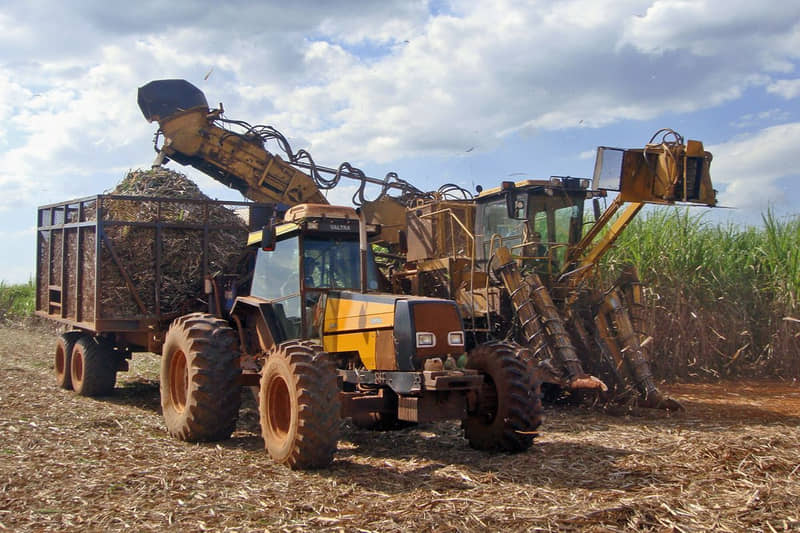
- Crushing. Sugarcane is received, weighed, washed and crushed to extract the juice. The fibre residue (bagasse) is burned to generate the steam and electricity the mill needs.
- Clarification. The raw juice is heated, treated with lime (calcium hydroxide) and settled or filtered to remove suspended solids, proteins and colloids.
- Evaporation. The clarified juice is concentrated in multi-effect evaporators, producing a thick syrup.
- Crystallisation. The syrup is fed into vacuum pans, where controlled cooling and seeding produce sucrose crystals in a mixture called massecuite.
- Centrifugation. The massecuite is spun in centrifuges to separate the crystals from the mother liquor (molasses). The crystals at this stage are raw sugar.
The refinery stage takes the raw sugar to white:
- Affination. The raw sugar crystals are mixed with a warm, concentrated syrup and centrifuged again. This washes the film of molasses off the crystal surface without dissolving the crystal itself.
- Melting. The affinated crystals are dissolved in hot water to produce a liquor.
- Clarification and decolourisation. The liquor is treated to remove colour bodies and remaining impurities. The method varies: carbonatation (where carbon dioxide is passed through a limed liquor and the calcium carbonate precipitate adsorbs colour), phosphatation (a similar principle with phosphoric acid), or direct decolourisation through activated carbon or ion-exchange resin. Some refineries use a combination.
- Recrystallisation. The decolourised liquor is evaporated and crystallised in vacuum pans, producing the refined sugar crystals.
- Drying and cooling. The crystals are dried in rotary or fluidised-bed dryers and cooled before being conveyed to storage or packaging.
The degree of decolourisation and the number of recrystallisation stages determine the final ICUMSA colour. An ICUMSA 45 sugar has typically been through a more intensive or repeated clarification and crystallisation path than an ICUMSA 100 or 150.
Brazil and the global trade in white granulated sugar
Brazil is the world's largest producer and exporter of sugar. The Centre-South region — principally the states of Sao Paulo, Minas Gerais, Goias, Mato Grosso do Sul and Parana — accounts for the large majority of Brazilian production and operates on a crop year that opens on 1 April and runs through November, with the inter-harvest from December to March. The North-East harvest runs on the opposite calendar, roughly September to April. Both calendars and their implications for shipment timing are set out on the crop calendar page.
Brazil exports roughly 27 million tonnes of sugar per year, according to UNICA (the Sugarcane and Bioenergy Industry Association) and the federal trade statistics published through Comex Stat. That volume comprises raw sugar (mainly VHP, sold as refinery feedstock) and white refined grades. The white grades — ICUMSA 45, 100 and 150 — move to end-use markets across the Middle East, Africa, South-East Asia, Central Asia and parts of the Americas. The destination determines the grade: markets with domestic refining capacity tend to import raw sugar and refine it locally, while markets without that capacity import white refined sugar ready for retail or for food manufacturing.
Brazilian white granulated sugar is loaded primarily through the port of Santos (the largest sugar-export port in the world), the port of Paranagua and the sugar terminals at Maceio and Recife. A shipment from Santos to the Arabian Gulf takes roughly 25 to 30 days; to East Africa, 20 to 25 days; to South-East Asia, around 30 days via the Suez Canal or the Cape.
The world white sugar price is referenced against the ICE No. 5 (London White Sugar) futures contract, which is denominated in US dollars per tonne. The raw sugar reference is the ICE No. 11 (New York). The difference between the two — the white premium — reflects the cost of refining and the supply-demand balance for white sugar specifically. The relationship between these benchmarks and a physical cargo price is covered in the sugar prices post.
The mix between sugar and ethanol production is a distinctive feature of the Brazilian industry. Mills can direct cane juice toward sugar crystallisation or toward ethanol fermentation, and the split is set season by season — or even fortnight by fortnight — based on relative economics. When the ethanol parity price is high relative to the sugar price, more of the cane goes to ethanol, and sugar availability tightens. When the sugar price is high, the mix shifts toward sugar. This flexibility is part of what makes the Brazilian supply dynamic different from that of any other origin.
Packaging and shipping
White granulated sugar for export is packaged in one of three standard formats, determined by the buyer's downstream handling and the destination market's requirements:
Polypropylene (PP) bags, 25 kg or 50 kg. These are the most common format for markets where the sugar will be repacked for retail, sold through wholesale distribution, or delivered to small and medium food manufacturers. The bags are woven PP, often with an inner polyethylene liner to protect against moisture. They are palletised or hand-stowed in dry containers. A standard twenty-foot equivalent unit (TEU) container carries approximately 25 tonnes of bagged sugar (500 bags of 50 kg, or 1,000 bags of 25 kg).
Flexible intermediate bulk containers (FIBCs), 1,000 kg or 1,250 kg. Also called jumbo bags or big bags. These are used by food manufacturers and industrial buyers who receive the sugar in bulk quantities and feed it directly into their process. FIBCs are loaded into containers by forklift. A TEU container holds approximately 20 to 22 FIBCs, or about 20 to 27 tonnes depending on bag size and stacking.
Bulk (break-bulk or vessel charter). For very large volumes — typically 10,000 tonnes or more per shipment — sugar is loaded in bulk into the hold of a dry-bulk vessel. Bulk shipments are more common for raw sugar than for white refined grades, but bulk white sugar shipments are done, particularly for large programme contracts to major destination terminals equipped for bulk discharge.
Containers are loaded under the supervision of a surveyor, who records the weight, the seal number and the condition of the cargo. The surveyor's loading certificate is one of the documents in the shipping set.
Buying white granulated sugar in bulk: what to specify
A workable enquiry for white granulated sugar from Brazil should contain at minimum:
- The grade, stated as the ICUMSA colour ceiling — ICUMSA 45, ICUMSA 100 or ICUMSA 150 — together with any specification parameters that your market or your process requires beyond the standard set (for example, a lower SO₂ limit, a specific granulation range, or a halal or kosher certification).
- The tonnage, and whether it is a single shipment or a programme of shipments spread over several months.
- The destination port.
- The Incoterm — FOB Santos, CFR destination, CIF destination. The Incoterm determines who arranges the freight and insurance, and it is one of the largest variables in the landed cost.
- The packaging — 50 kg PP bags, 25 kg PP bags, FIBCs or bulk.
- The shipment window — the month or date range within which the cargo should load. If timing is critical, the crop calendar explains the seasonal dynamics that affect lead times.
With those six items, a supplier can return a firm offer priced against the current market, rather than a request for clarification. Minimum order quantity, available Incoterms, port of loading, payment terms and lead time are confirmed on quotation, because each one moves with the destination, volume and timing of the shipment.
Documents a buyer should expect
A standard documentary set for a shipment of white granulated sugar from Brazil includes:
- Commercial invoice — describes the goods, the quantity, the unit price and the total amount, referencing the contract.
- Packing list — states the number and type of packages, their weights and the container or hold details.
- Bill of lading — issued by the carrier, confirming the cargo has been received for shipment. It is the document of title.
- Certificate of origin — issued by an accredited entity under SECEX (the Foreign Trade Secretariat), stating the Brazilian origin of the goods. The certificate carries the HS code subheading and is required for preferential tariff treatment in many importing markets.
- Certificate of quality / certificate of analysis — issued by an independent inspection company (typically SGS, Bureau Veritas, Intertek or Control Union), confirming the physical and chemical parameters of the lot: polarisation, ICUMSA colour, moisture, ash, SO₂, granulation and any other parameters specified in the contract.
- Phytosanitary certificate — issued by the Brazilian Ministry of Agriculture (MAPA), confirming the cargo is free from pests and diseases.
- Certificate of weight — issued by the surveyor at loading, confirming the weight of the cargo.
- Fumigation certificate — when required by the destination country, confirming that the cargo has been fumigated against insect infestation.
If the transaction is financed by a documentary letter of credit, the L/C will list which of these documents the bank requires as a condition of payment, and the description of goods on the L/C must match the description on the invoice and the other documents. Discrepancies in the document set are one of the most common causes of payment delays in the sugar trade — they are covered in detail on the trade documents page.
For any enquiry — whether for ICUMSA 45, ICUMSA 100, crystal white sugar or any combination — send us the six specification items above and the first reply will be a quotation, not a questionnaire.
Sources
- ICUMSA — International Commission for Uniform Methods of Sugar Analysis. The referenced colour measurement method is ICUMSA Method GS2/3-9 (sugar solution colour at pH 7.0).
- UNICA — Sugarcane and Bioenergy Industry Association. Fortnightly crush reports and annual production and export statistics for the Centre-South region.
- Comex Stat — the official Brazilian foreign-trade statistics portal of the Ministry of Development, Industry, Trade and Services. NCM-level export data for heading 1701.
- WCO Harmonised System — the authority for the subheading structure and Subheading Notes referenced in the classification discussion.