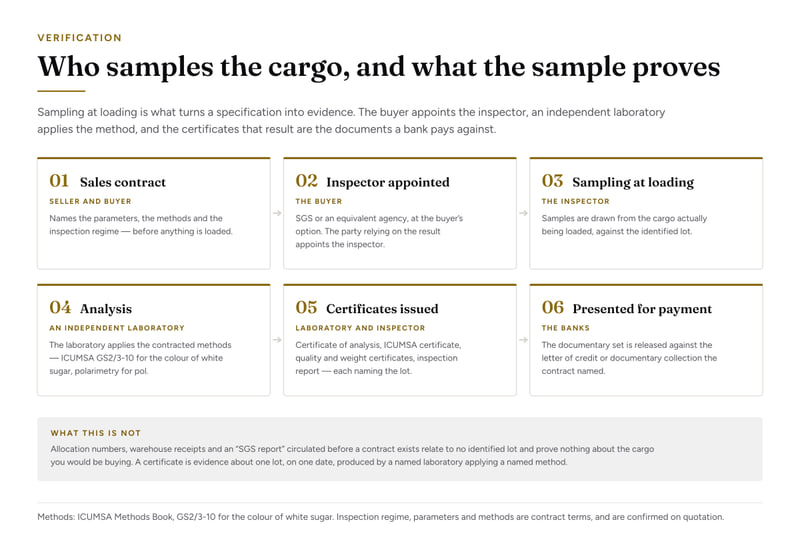
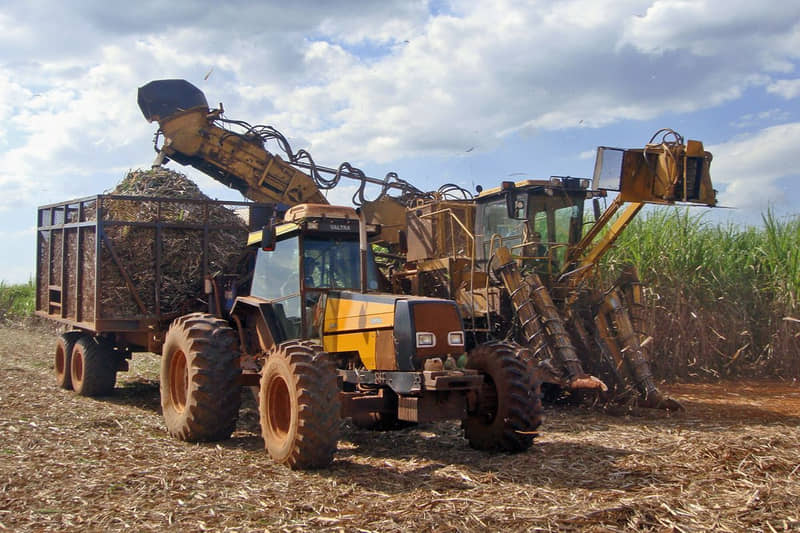
Mechanical harvesting in the Centre-South, where the crush opens on 1 April. Photo: Mariordo (Mario Roberto Duran Ortiz), CC BY 3.0, via Wikimedia Commons.
Brazil harvests sugarcane on two calendars. In the Centre-South, which is where the great majority of Brazilian export sugar comes from, the crop year opens on 1 April and mills normally crush until late November or early December, then stand idle through the inter-harvest until the following March or April. In the North-East the cycle is reversed: CONAB puts that harvest at roughly September to April. Nothing in either calendar means refined sugar is unavailable for part of the year — but both affect lead times, and one of them explains why a February enquiry and a June enquiry are answered by different parts of the supply chain.
This page sets out both calendars, the reason they differ, and what each actually does to availability, pricing and shipment dates for a bulk buyer.
Brazil has two cane calendars, not one
Brazil is large enough to contain two distinct cane-growing climates, and the harvest in each follows that region's dry season.
- Centre-South — São Paulo, Minas Gerais, Goiás, Mato Grosso do Sul, Paraná. This is the region we source from — we are an export trading company buying from Brazilian mills, not a mill — and it supplies the great majority of Brazilian export sugar. UNICA, the industry association that publishes the fortnightly crush data the market trades on, reports this region on a crop year that runs from 1 April to 31 March, written in the trade as 2026/27.
- North and North-East — Alagoas, Pernambuco, Paraíba and neighbouring states. CONAB, the federal crop agency, describes the country as following two harvest calendars, with the North-East harvested from roughly September to April and the rest of the country from roughly May to November.
The two agencies frame the Centre-South slightly differently, and the difference is worth understanding rather than smoothing over: CONAB describes the harvest of the fields, which gets going in earnest in May, while UNICA reports the crush, which opens with the crop year on 1 April and in some years sees mills restarting earlier, in the second half of March. In practice the Centre-South campaign is an April-to-November operation with ragged edges at both ends.
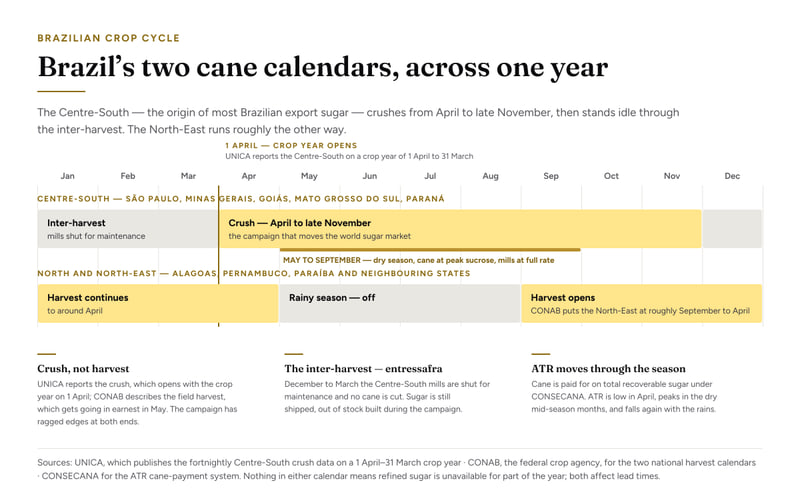
The two calendars side by side across a single year.
The Centre-South: 1 April to late November
The Centre-South campaign is the one that moves the world sugar market, and it runs on a rhythm a buyer can plan around.
April. The crop year opens. Early-season cane carries less recoverable sugar than mid-season cane, so the first weeks of crushing produce proportionally more ethanol and less sugar in many mills.
May to September. The core of the campaign. This is the dry, cooler part of the year in the Centre-South, when cane accumulates sucrose, the fields are trafficable for mechanical harvesters, and mills run at full rate. Most of the season's sugar is made in this window.
October to early December. The rains return, recoverable sugar in the cane falls, harvesting slows, and mills close one by one. A late-season harvest is more weather-dependent than a mid-season one.
December to March — the inter-harvest, the entressafra. Mills are shut for maintenance. Cane is not being cut. Sugar is still being shipped, from stock built during the campaign.
Within that cycle, cane quality is measured and paid for on ATR — açúcar total recuperável, total recoverable sugar — under the CONSECANA system by which Brazilian mills buy cane from independent growers. ATR is the number that tells a mill how much sugar is actually in the cane it is crushing this fortnight, and it moves through the season: low at the start, peaking in the dry mid-season months, falling again with the rains.
The North-East runs the other way: September to April
The North-East's rainfall arrives in the southern-hemisphere autumn and winter — roughly April to July — which is precisely when the Centre-South is dry. So the harvest window is displaced by about half a year, running from around September through to April, and the region's mills are crushing while the Centre-South is in its inter-harvest.
For a buyer, the North-East is a smaller, more locally oriented industry than the Centre-South, and it is not the usual origin for a large export programme. Its value here is analytical: Brazil as a whole is never entirely out of harvest, which is part of why Brazilian supply is more continuous than a single regional calendar suggests.
Why the harvest follows the dry season
Three reasons, and they all point the same way.
- Sucrose accumulates when growth slows. Cane stores sugar in the stalk as the dry season checks vegetative growth. Cutting too early means cutting cane that has not finished accumulating.
- Fields have to carry the machinery. Mechanical harvesters and the trucks that follow them cannot work saturated soil without damaging the ratoon — the stubble that produces next year's crop from the same planting.
- Cane cannot be stored. Once cut, cane begins to lose sucrose within hours, which is why mills crush continuously through the campaign and why the cutting front is managed around the mill's daily rate rather than the other way around. How a Brazilian mill turns cane into sugar describes that process end to end.
What the calendar changes for a buyer, and what it does not
This is the part that is misunderstood most often, in both directions. The crop calendar matters, but it does not matter in the way people assume.
What it does not change. Refined white sugar is a storable, non-perishable product held in warehouses, and refineries do not stop in December. Refined white ICUMSA 45 is available year-round and quotable year-round. The inter-harvest is not a closed season for buying sugar from Brazil.
What it does change:
- Prompt availability of raw grades. VHP and raw brown cane sugar track the crush much more closely than refined grades do, because raw sugar is a mill output moving towards refineries and distilleries rather than a warehoused finished product.
- How far forward you can be quoted. An enquiry against new-crop availability and an enquiry against sugar already in store are answered differently, and the second is quicker.
- Lead time, at the margins. Late in the inter-harvest the supply chain is working from the tail of last season's stock; early in the campaign it is working from fresh production. Both can ship; the sequencing differs.
- The price basis. Harvest progress is one of the inputs the world market prices every fortnight. How a price per tonne is built sets out the ICE No. 11 basis and the white premium — and the point in the crop cycle is one of the things that moves them.
The second switch: how much of the cane becomes sugar at all
A Brazilian mill is not only a sugar mill. Most Centre-South mills can direct the sucrose they recover either to sugar or to ethanol, and they shift that split within technical limits according to the relative returns of the two products. UNICA publishes the sugar–ethanol mix alongside the crush in its fortnightly reports, which is why the market watches those releases closely.
The consequence for a buyer is that the volume of sugar reaching the export market in a given fortnight is set by two variables, not one: how much cane was crushed, and what share of its recoverable sugar was turned into sugar rather than ethanol. A record crush does not automatically mean abundant sugar, and this is the single most useful thing to understand about Brazilian supply that is not on the crop calendar at all.
What actually sets your shipment date
In our experience, the crop calendar is rarely the binding constraint on a shipment date. The sequence that sets it is this:
- Specification agreed. Grade, ICUMSA colour ceiling, polarisation, packaging. A specification left open here delays everything after it.
- Quotation and contract. Priced against the market on the day, valid for a stated window.
- Payment instrument in place. A documentary letter of credit takes as long as the buyer's bank takes, and that is frequently the longest single step.
- Booking. Vessel or container space, and a berth window at the terminal.
- Stuffing or loading, and inspection if the buyer has appointed an independent inspector.
- Documents. Certificate of analysis for the lot, certificate of origin, bill of lading, and whatever else the contract and the L/C call for. What each document proves, and which ones are not documents at all, is set out in sugar trade documents and how to verify a supplier.
Our own lead time, minimum order quantity, Incoterms, port of loading, payment terms and packaging are confirmed on quotation, because each one moves with destination, volume and the point in the cycle — which is the honest answer rather than a published figure that would not hold in February and in July alike.
The loading window is shared with soybeans and maize
One practical point that no crop calendar shows. Santos and Paranaguá, the two ports our cargoes load at, are not sugar terminals; they are Brazil's main agricultural export gateways, and sugar's loading window overlaps the soybean and maize export programmes at the same complexes. We plan around berth and equipment availability as much as around the crush, because in parts of the year the constraint on a shipment date is the terminal, not the sugar.
That is also why a shipment window stated in an enquiry is genuinely useful information rather than a formality. Told the window, a seller can book against it. Not told, the cargo gets whatever space is left. The other thing worth settling that early is the tariff line the cargo will be declared under, which turns on polarisation rather than colour — see the sugar HS code and heading 1701.
How to time an enquiry through the year
| When you enquire | What the supply chain is doing | What to ask for |
|---|---|---|
| January – March | Centre-South mills shut for maintenance; shipments from stored sugar; North-East still harvesting | Prompt shipment of refined grades from stock; early indications for new-crop raw |
| April – June | New crop year open, crush ramping up, early-season cane | New-crop raw and VHP; multi-shipment programmes for the season ahead |
| July – September | Peak crush, highest recoverable sugar, highest port activity | Firm programmes; book the loading window early, not the tonnage late |
| October – December | Crush winding down, weather risk rising, mills closing | Confirm shipment windows in writing; expect availability questions on raw grades first |
In every one of those quarters, the useful enquiry contains the same six things: grade and ICUMSA figure, tonnage, destination port, Incoterm, packaging, and shipment window. Send those six and the first reply can be a quotation.
The inter-harvest is not a supply gap
It is worth ending on this, because it is the claim this page exists to correct. A supplier who tells you sugar cannot be shipped from Brazil in the inter-harvest is describing a mill's calendar, not an exporter's. A supplier who tells you the crop calendar has no effect on anything is not describing raw-grade availability honestly either.
The accurate position is the narrow one: refined white sugar is available and quotable all twelve months; raw grades follow the crush more closely; and the dates that actually bind on a shipment are the payment instrument and the berth, both of which are inside the buyer's and seller's control in a way the weather in Ribeirão Preto is not. If you are choosing a grade before you worry about timing, start with the ICUMSA colour scale and grade chart, then come back to the calendar.
Crop calendar last reviewed 19 October 2026.
Sources
-
UNICA — União da Indústria de Cana-de-Açúcar e Bioenergia. Its fortnightly Centre-South reports are the industry's reference series for cane crushed, sugar and ethanol produced, and the sugar–ethanol mix, published against a crop year that opens on 1 April. We cite UNICA as a data publisher; we are a trading company and not a member of it.
-
CONAB — Companhia Nacional de Abastecimento, the federal crop agency, whose sugarcane survey bulletins set out the two national harvest calendars, with the North-East harvested from around September to April and the remainder of the country from around May to November, and which publishes four survey rounds per season.
-
CONSECANA — the cane payment system under which Brazilian mills buy grower cane on ATR, total recoverable sugar, which is the published basis on which cane quality is measured through the season.
-
ICE Futures — the No. 11 raw sugar and No. 5 white sugar contracts, against which physical cargoes are priced and whose movements reflect harvest progress among other inputs.
Where this page describes our own practice — ports of loading, planning around berth availability, what is confirmed on quotation — that is a statement about this business. Where it describes the Brazilian crop, UNICA and CONAB are the authorities and their current bulletins should be preferred to any secondary source, including this one.