Industrial sugar is sugar bought by volume, to a written specification, for use as a manufacturing input rather than a retail product. The same sucrose molecule sits in a kitchen bag and in a 50-tonne lot destined for a soft-drink bottler, but the way it is specified, tested, packaged and priced has almost nothing in common between the two. If you are sourcing sugar for a production line — food, beverage, pharmaceutical, fermentation or any other process — this page sets out the grades available, how each industry specifies them, and how bulk sugar suppliers in Brazil fulfil those specifications at scale.
What makes sugar industrial grade
There is no ISO definition of "industrial sugar" as a separate product. The distinction is commercial, not chemical: it is the difference between a consumer pack and a manufacturing input. In practice, three things separate an industrial purchase from a retail one.
Volume. Industrial buyers purchase in lots of hundreds or thousands of tonnes per shipment, not pallets. The unit of trade is the metric tonne, and a single vessel loading at Santos or Paranagua will carry 12,500 to 50,000 tonnes of sugar in one cargo.
Specification. A retail buyer chooses a brand. An industrial buyer writes a purchase specification — colour, polarisation, granulation, moisture, ash, sulphur dioxide, microbiological limits — and the sugar delivered must meet every line on that specification, verified by a certificate of analysis for the lot shipped. The ICUMSA colour scale is the grading system the international trade uses, and it is worth understanding before writing a spec.
Packaging and handling. Retail sugar leaves a warehouse in 1 kg bags on a pallet. Industrial sugar ships in 50 kg polypropylene bags, 1,000 kg (one-tonne) jumbo bags (FIBCs), or as bulk cargo in a vessel's hold. The choice depends on the buyer's receiving equipment, storage and dosing method.
None of these differences changes the sugar itself. What differs is the commercial wrapper: the minimum order, the documentation, the testing regime and the logistics.
The grades: which ICUMSA range serves which industry
Industrial buyers use the ICUMSA colour number as shorthand for a grade. A colour number is not a complete specification, but it is where most procurement conversations start, because different industries cluster around different ranges.
| ICUMSA colour range | Trade name | Typical industrial use | Key specification concern |
|---|---|---|---|
| ICUMSA 45 or below | Refined white | Beverage production, pharmaceutical excipients, dairy, confectionery where whiteness matters | Colour ceiling, low ash, low SO₂, microbiological limits |
| ICUMSA 100--150 | Crystal white / plantation white | Confectionery, biscuits, bakery, cereal manufacturing, general food processing | Granulation (crystal size distribution), colour, moisture |
| ICUMSA 600--1200 | Raw brown / VHP | Fermentation, bioethanol, animal feed, re-refining at a destination refinery | Polarisation (sucrose content), moisture, dextran |
| Liquid sucrose / invert syrup | Liquid sugar | Beverage lines that dose by volume, confectionery centres | Brix, invert ratio, microbiological — but this is 1702, not 1701 |
The table is a starting point. A soft-drink manufacturer may accept ICUMSA 100 for a caramel-coloured product and insist on ICUMSA 45 for a clear one. A pharmaceutical company may require ICUMSA 35 because the pharmacopoeia monograph sets a tighter colour ceiling. A fermentation plant does not care about colour at all but cares a great deal about polarisation, because polarisation is the sucrose yield.
The sections below work through each industry, then set out the specification parameters that apply across all of them.
Industry by industry: how specifications diverge
Food manufacturing
Food manufacturers — confectionery, bakery, biscuit, cereal, dairy, canned goods — are the largest single category of industrial sugar buyers globally. Their requirements vary more than any other group because they make different products on different lines, but a few generalisations hold.
Granulation matters as much as colour. A biscuit line running sugar through a dry mixer needs a consistent crystal size distribution so the sugar dissolves uniformly in the dough. Granulation is stated as a mean aperture (MA) in millimetres and, where tighter control is required, as a coefficient of variation (CV).
Moisture must be low. Moisture causes caking in storage and inconsistent dosing in automated systems. Industrial food-grade sugar is typically specified below 0.06% moisture for refined white and below 0.15% for crystal grades.
Microbiological limits are set by the buyer, not the seller. Food manufacturers operating under HACCP or BRC will write yeast, mould and total plate count ceilings into the purchase specification. Results appear on the certificate of analysis alongside the physical and chemical parameters.
Beverage production
Bottlers and beverage manufacturers are the most specification-sensitive category of industrial sugar buyer. The sugar dissolves completely in the product, so every impurity the sugar carries is an impurity in the drink.
ICUMSA 45 refined white sugar is the standard grade for carbonated soft drinks, juices, flavoured waters and energy drinks. Colour is the headline specification — 45 ICUMSA units maximum — but beverage buyers also set ceilings on ash (which affects taste), SO₂ and sediment. Some global bottlers maintain their own specifications tighter than the ICUMSA 45 trade standard. If you hold one, send it with the enquiry — not after.
Liquid sucrose is an alternative for lines that dose by volume rather than weight, but it is a different product classified under HS heading 1702, not 1701 and ships in isotanks rather than bags.
Pharmaceutical and nutraceutical
Sugar used as a pharmaceutical excipient — in tablet coatings, syrups, granulations and suspensions — must conform to the relevant pharmacopoeia: the United States Pharmacopeia (USP), European Pharmacopoeia (Ph.Eur.) or the pharmacopoeia of the destination market. These monographs set tighter limits for colour, conductivity ash, sulphated ash, lead, reducing sugars and microbiological counts than the food trade normally applies.
Pharmaceutical buyers typically require ICUMSA 45 or ICUMSA 35, and they will ask for a certificate of analysis referencing the pharmacopoeia method. If you are buying sugar for a GMP-regulated facility, state the pharmacopoeia in the enquiry.
Fermentation and bioethanol
Fermentation is the second-largest industrial use of sugar globally, and it is the use that cares least about appearance and most about yield. What a distillery or an ethanol plant buys is sucrose content — measured as polarisation — because every degree of polarisation is a predictable quantity of fermentable sugar.
Raw brown cane sugar in the ICUMSA 600--1200 range, including VHP (very high polarisation) sugar, is the standard feedstock. The buyer specifies a minimum polarisation — typically 99.0 degrees or above for VHP — and sets ceilings on moisture and dextran. Dextran is a polysaccharide produced by bacterial action on cut cane, and above certain concentrations it interferes with both the fermentation process and the downstream separation.
Colour is irrelevant. Granulation is largely irrelevant, because the sugar is dissolved before it enters the fermenter. What matters is sucrose per tonne delivered.
Re-refining
Destination refineries in the Middle East, North Africa and South-East Asia that import raw sugar and refine it locally are also industrial buyers. They buy VHP or VVHP raw cane sugar, and their specifications are driven by the yield of their refining train: polarisation, moisture, colour, grain size and starch.
How industrial buyers specify sugar
Regardless of the end use, the specification a buyer writes and the certificate of analysis a seller provides share a common set of parameters. These are the lines that matter.
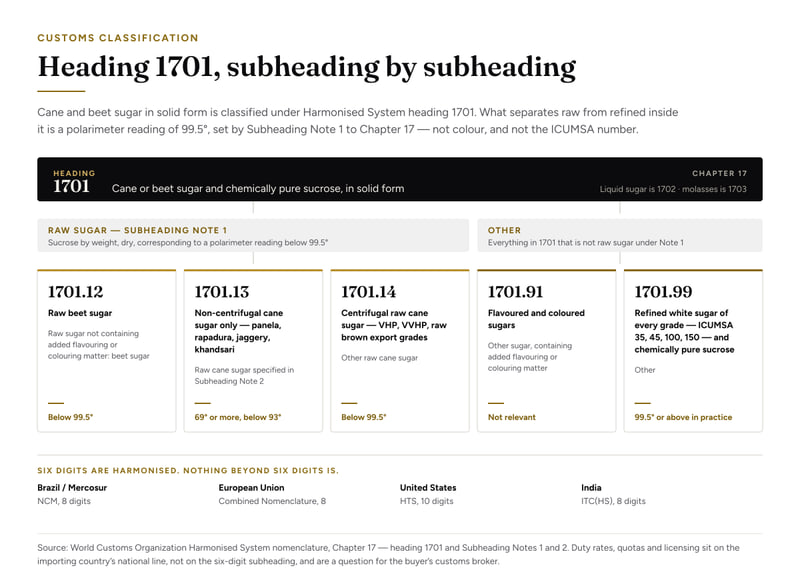
Polarisation. The sucrose content of the sugar, measured polarimetrically. For refined white grades it is typically 99.80% minimum. For raw grades it is the primary value parameter. Polarisation also determines the HS customs classification: the 99.5-degree threshold separates raw from refined in the Harmonised System nomenclature, regardless of colour.
ICUMSA colour. The colour of the sugar in solution, measured by an ICUMSA method (GS2/3-10 for white sugars, GS1/3-7 for raw sugars). The number is what gives the grade its name — ICUMSA 45, ICUMSA 100, ICUMSA 600--1200 — and it is stated as a maximum on the contract.
Granulation (MA and CV). The mean crystal size and its uniformity. Stated in millimetres for the mean aperture and as a percentage for the coefficient of variation. Important for any process that dissolves, mixes or conveys the sugar dry.
Moisture. Stated as a maximum percentage. Low moisture prevents caking, ensures accurate dosing and extends storage life. Typical ceilings: 0.04% for refined white, 0.06--0.10% for crystal, 0.15--0.25% for raw.
Ash. Mineral residue. Relevant for taste in beverages and for purity in pharmaceuticals. Stated as conductivity ash for refined grades.
SO₂. Sulphur dioxide residual from the refining process. Regulated as a food additive in most jurisdictions. Beverage and pharmaceutical buyers set a ceiling, often 20 mg/kg or lower.
Microbiological limits. Total plate count, yeast, mould and, where specified, coliforms and Salmonella. These are buyer-specified and tested per lot.
Dextran. Relevant for raw sugar going to fermentation or re-refining. Stated as a maximum in mg/kg.
Not every parameter appears in every specification. A fermentation buyer will not set an SO₂ ceiling. A beverage buyer will not specify dextran. The point is that the parameters are well-defined, the methods are standardised, and the certificate of analysis for the lot shipped is the document that proves compliance.
Why Brazil dominates the industrial sugar supply
Brazil is the world's largest sugar producer and the largest exporter by a wide margin. Several structural facts explain why bulk sugar suppliers sourcing from Brazil can offer what industrial buyers need.
Scale. Brazil exports roughly 40% of all sugar moving in international trade. No other origin comes close to that export surplus. India, the second-largest producer, has a large domestic market and swings between exporting and restricting exports depending on domestic production and government policy.
Mill count and competition. The Centre-South — Sao Paulo, Minas Gerais, Goias, Mato Grosso do Sul and Parana — has several hundred operating mills. That density means competition on quality and specification compliance, and it means a buyer sourcing through a Brazilian trading company is not locked to one mill.
Year-round availability. The Centre-South crush runs from April through November or early December. During the inter-harvest, refined sugar remains available from stock. Raw sugar is stored in terminal warehouses at Santos and Paranagua. The practical result is that industrial buyers can contract year-round, though lead times shift with the crush calendar.
Port infrastructure. Santos and Paranagua are among the largest sugar-loading ports in the world, with dedicated terminals that handle bulk and bagged cargo. Sugar trades FOB Santos or FOB Paranagua on the ICE No. 11 and No. 5 benchmarks.
Grade range. Brazilian sugar manufacturers produce every grade an industrial buyer is likely to need: refined white at ICUMSA 45 and ICUMSA 35, crystal at ICUMSA 100 and 150, and raw brown at ICUMSA 600--1200. A single Brazilian trading company can source all of them, which simplifies the sugar supply chain for a manufacturer that uses more than one grade.
Minimum order quantities and logistics
Industrial sugar is a bulk commodity. The logistics are set up for volume, and the minimums reflect that.
Minimum order quantity. For bagged sugar (50 kg bags or 1,000 kg jumbo bags), a practical minimum is a full container — roughly 25 to 27 tonnes in a 20-foot container. For vessel-lot quantities, the standard unit is a Panamax or Supramax vessel: 25,000 to 35,000 tonnes for a Panamax, 45,000 to 60,000 tonnes for a Supramax loading bulk. Smaller lots are possible but the per-tonne freight cost rises, and below a container load the logistics stop being economical for commodity sugar.
Packaging options. 50 kg polypropylene bags with an inner polyethylene liner, palletised or loose in the container. 1,000 kg jumbo bags (FIBCs) with a liner. Bulk, loaded directly into a vessel's hold or into a container with a bulk liner. The choice is stated in the contract.
Incoterms. Brazilian sugar is commonly quoted FOB (port of loading), CFR (cost and freight, named destination port) or CIF (cost, insurance and freight). The Incoterm determines who pays for ocean freight and insurance and where risk transfers.
Lead time. During the Centre-South crush, a standard lead time for a bagged container is two to four weeks from contract to loading. Vessel lots take longer to programme. Outside the crush, availability from stock may shorten the production lead time but port scheduling remains a variable.
Quality documentation industrial buyers require
Industrial buyers, particularly those operating under food safety management systems, require a documentation set that goes beyond a commercial invoice. The standard documents for a Brazilian sugar export are as follows.
Certificate of analysis. The laboratory report for the lot shipped, stating the analytical results for every parameter in the contract specification: polarisation, colour, moisture, ash, SO₂, granulation and any microbiological parameters the buyer has specified. Issued per lot, not per grade — this is the document that proves the sugar meets the specification.
Certificate of origin. Issued through an entity accredited by SECEX, the Brazilian Foreign Trade Secretariat. For buyers in markets with preferential tariff arrangements — Arab League countries in particular — the certificate of origin determines the duty rate on import and is a line item in the landed cost.
Phytosanitary certificate. Issued by MAPA, the Brazilian Ministry of Agriculture. Required by the importing country's plant health authority. It certifies that the cargo has been inspected and is free from quarantine pests. Some importing countries require additional fumigation certificates.
Certificate of purity and ICUMSA certificate. The laboratory's report of the sugar's colour, measured by an ICUMSA method. Note that there is no such thing as "ICUMSA certification" of a producer — ICUMSA publishes analytical methods and does not inspect cargo or certify mills.
Weight certificate. Issued at loading, confirming the weight of the cargo.
Independent inspection report. Where the contract calls for it, an inspection by SGS, Bureau Veritas, Intertek or an equivalent agency, covering quality, weight and packing condition.
Bill of lading. The transport document issued by the carrier. For a documentary letter of credit, the bill of lading must match the credit terms exactly.
If your food safety system requires a supplier questionnaire, a HACCP declaration, or allergen and GMO statements, send those with the enquiry. They are answered as part of the quotation process, not as an afterthought.
How to start a bulk enquiry
If you are sourcing industrial sugar for a manufacturing operation, the fastest path to a real quotation is to send the following with your first message:
- The grade — ICUMSA colour ceiling and, if you have one, the full purchase specification.
- The tonnage — per shipment and per year, if it is a programme.
- The destination port.
- The Incoterm you want the price quoted on.
- The packaging — 50 kg bags, jumbo bags, or bulk.
- The shipment window — when you need the cargo to arrive.
With those six items, we can confirm availability, match the specification to a mill and a lot, and return a quotation in one exchange rather than three. Minimum order quantity, payment terms, lead time and documentation are confirmed on the quotation.
Send your enquiry and we will reply with a specification confirmation and a price.