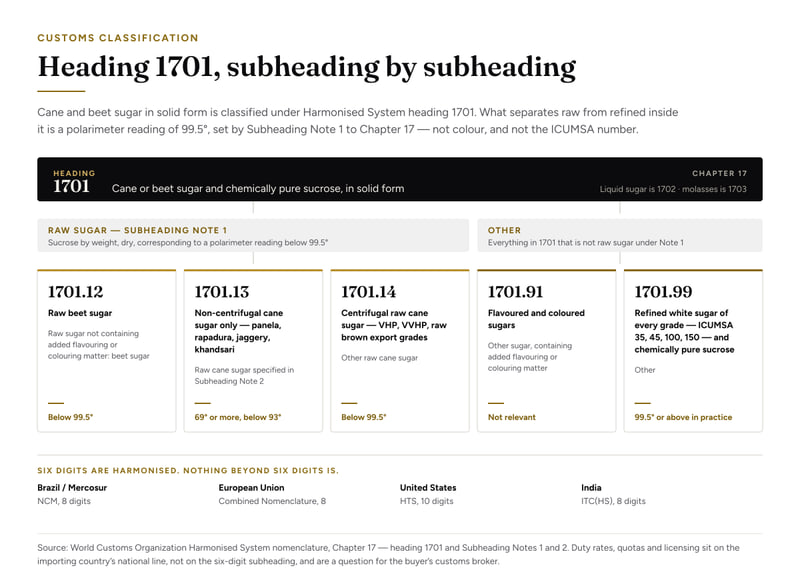
VHP sugar is the form in which most of the world's raw cane sugar moves between countries. The abbreviation stands for Very High Polarisation, which describes the grade's defining characteristic: a sucrose content high enough to make it an efficient feedstock for a destination refinery, but without the cost of full refining at origin. This page explains what VHP is, what its specifications mean, how it is produced and traded, and what a buyer should know before contracting it.
What VHP stands for
VHP stands for Very High Polarisation. Polarisation is a measurement of sucrose content, expressed in degrees (°Z or °S) on a polarimeter. A VHP sugar with a polarisation of 99.3° contains at least 99.3 percent apparent sucrose by the polarimetric method. The name describes the grade — it is raw sugar whose polarisation is higher than standard plantation white or mill white, but that has not been refined to the colour levels of ICUMSA 45 or ICUMSA 100.
The term is used almost exclusively in the cane sugar trade. Beet sugar does not pass through a VHP stage because beet factories refine in a single continuous process.
How VHP differs from other raw sugars
Raw cane sugar exists on a spectrum. At one end is muscovado — dark, high-moisture, high-molasses, with polarisation around 86° to 89°. At the other end is VHP — pale brown to golden, relatively dry, with polarisation above 99°. In between sit various grades of demerara, plantation white and standard raw sugar.
| Grade | Typical polarisation | Typical colour | Moisture | Primary use |
|---|---|---|---|---|
| Muscovado | 86°–89° | Dark brown | 1.5–3.0% | Specialty food, direct consumption |
| Standard raw | 96°–98° | Brown | 0.5–1.0% | Refinery feedstock, ethanol |
| VHP | 99.0°–99.5° | Golden brown | 0.10–0.15% | Refinery feedstock |
| VVHP | 99.5°+ | Light golden | 0.06–0.10% | Refinery feedstock, low-loss refining |
The higher the polarisation, the more sucrose per tonne the refinery recovers and the less waste it handles. VHP exists because it is the most cost-effective point on this spectrum for long-distance trade: refined enough to minimise freight cost per unit of recoverable sucrose, but not so refined that origin-side processing costs eat the margin.
Typical VHP sugar specifications
A VHP sugar certificate of analysis will state most of the following parameters. The ranges below are representative of Brazilian VHP as traded in the international market.
| Parameter | Typical range | Notes |
|---|---|---|
| Polarisation | 99.30° minimum | The defining spec; some contracts specify 99.40° or higher |
| Colour (ICUMSA) | 600–1500 RBU | Measured by reflectance, not solution colour; the ICUMSA scale explains the difference |
| Moisture | 0.10–0.15% | At packing; lower than standard raw |
| Ash | 0.10–0.15% | Inorgite content by conductometric method |
| Reducing sugars | 0.05% maximum | Glucose and fructose; kept low to avoid inversion during storage |
| SO₂ (sulphur dioxide) | 20 mg/kg maximum | Residual from sulphitation; some buyers specify 15 mg/kg |
| Granulation | 0.6–1.2 mm (MA) | Mean aperture; coarser than refined white |
| Dextran | 150 mg/kg maximum | A polysaccharide from bacterial action; high dextran complicates refining |
| Starch | 150 mg/kg maximum | High starch causes filtration problems at the refinery |
| Magnetic particles | 4 mg/kg maximum | From milling equipment; food-safety parameter |
Not every contract names every parameter. Polarisation, colour and moisture are universal. Dextran and starch matter to refineries that process at high throughput, because these substances slow filtration and reduce yield. A buyer whose refinery is sensitive to dextran should state a ceiling in the contract rather than relying on a standard range.
How VHP sugar is produced
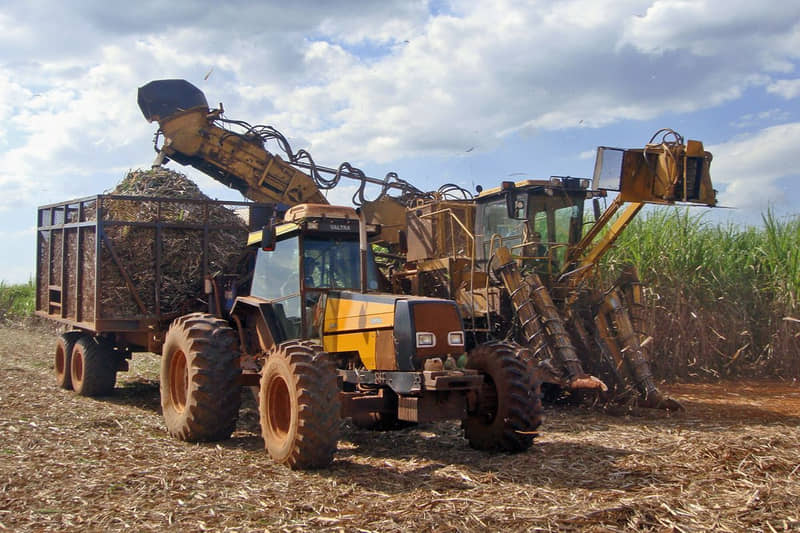
VHP is produced at a sugar mill — the same facility that produces ethanol from sugarcane in Brazil's integrated mill model. The process follows the same path as any raw sugar until the centrifugation stage:
-
Crushing. Sugarcane is crushed or diffused to extract juice with a sucrose content of 10 to 15 percent.
-
Clarification. The juice is heated and treated with lime (calcium hydroxide) to precipitate impurities, then filtered or settled.
-
Evaporation. The clarified juice is concentrated in multiple-effect evaporators to produce a syrup of roughly 60 to 65 percent solids.
-
Crystallisation. The syrup is boiled under vacuum in a pan until sugar crystals form. The crystal mass and surrounding mother liquor — called massecuite — is then discharged.
-
Centrifugation. The massecuite is spun in a centrifuge to separate crystals from molasses. For VHP, the centrifugation is more aggressive than for standard raw sugar: more molasses is removed, raising the polarisation and lowering the colour and moisture of the crystals.
-
Drying. The crystals are dried in a rotary drum to the target moisture, typically 0.10 to 0.15 percent.
The result is a free-flowing golden-brown crystal. The key difference between VHP and standard raw sugar is the degree of centrifugation and drying — VHP is spun harder and dried longer, which strips more molasses and produces a higher-pol, lower-moisture crystal. No additional refining chemicals are applied. VHP is not bleached, carbonated, or ion-exchanged; those steps belong to the refinery at destination.
Why refineries choose VHP as feedstock
A destination refinery buys VHP rather than a lower-grade raw sugar for three reasons:
Higher recovery. A tonne of VHP at 99.3° polarisation yields more refined white sugar than a tonne of standard raw at 97°. The refinery loses less to waste streams (molasses, filter cake, wash water), which means a lower cost per tonne of finished product.
Lower processing cost. Because VHP arrives with less colour and fewer non-sugar substances, the refinery uses fewer chemicals, less energy and less filtration capacity to bring it to ICUMSA 45 or ICUMSA 100. The shorter the refining path, the lower the variable cost.
Consistency. Brazilian VHP from established mills arrives within a narrow specification band, crop after crop. Consistency matters to a refinery running continuous process equipment: a sudden change in feedstock colour or dextran content disrupts the production schedule.
The trade-off is price. VHP costs more per tonne FOB than standard raw, because the origin mill does more work. But the total cost to the refinery — CIF raw plus refining cost minus by-product credits — is typically lower with VHP than with a cheaper, dirtier raw sugar that consumes more refining capacity.
Brazil's role in the global VHP trade
Brazil is the world's largest producer and exporter of VHP sugar. The Centre-South region — principally the states of São Paulo, Minas Gerais, Goiás, Mato Grosso do Sul and Paraná — produces the vast majority of Brazilian VHP during the crushing season that runs from April to November.
Brazilian mills are integrated sugar-ethanol operations. In any given season, a mill allocates its cane between sugar and ethanol based on relative prices, domestic ethanol mandates and export demand. When the sugar price is strong relative to ethanol, more cane goes to sugar and more VHP is available for export. This allocation decision is one of the factors behind the seasonal price behaviour of VHP on the world market.
Most Brazilian VHP is exported in bulk — loaded directly into a ship's hold at the ports of Santos, Paranaguá or Maceió — rather than in containers. Bulk shipments are measured in lots of 12,500 to 50,000 metric tonnes. Containerised VHP does exist, typically in FIBC (big bag) packaging of 1,000 or 1,250 kg, for buyers whose volumes do not justify a bulk vessel charter.
VHP sugar pricing and contracts
VHP sugar is priced against the ICE No. 11 raw sugar futures contract (now traded on ICE Futures US). The No. 11 contract is the global benchmark for raw cane sugar and is quoted in US cents per pound.
A typical VHP export contract is structured as:
- Price: ICE No. 11 plus or minus a premium or discount, in US cents per pound. The premium reflects quality (higher pol commands a premium), logistics (port proximity) and market conditions.
- Quantity: stated in metric tonnes.
- Shipment period: a window of typically 15 to 45 days within the crushing season.
- Quality: polarisation minimum, colour range, moisture maximum, and any additional parameters the buyer specifies.
- Incoterm: FOB Santos, FOB Paranaguá, or CFR/CIF destination port.
Spot prices fluctuate with the futures market, the Brazilian real exchange rate, port congestion and seasonal supply. Prices are confirmed on quotation and depend on the volume, shipment window and payment terms of the specific enquiry. This site does not publish prices; a current indication is available on request for a defined enquiry.
VHP versus VVHP
VVHP stands for Very Very High Polarisation. The distinction is not formalised in a standard, but in trade practice VVHP refers to raw sugar with polarisation above 99.5° — typically 99.5° to 99.7° — and colour in the lower part of the VHP range.
VVHP is produced by the same process as VHP, with tighter centrifugation and sometimes an additional washing step in the centrifuge. The result is a lighter, drier crystal that yields an even higher recovery at the destination refinery.
Not all mills produce VVHP as a standard grade. When it is available, it commands a premium over VHP because of the higher sucrose recovery and the lower refining cost at destination. A buyer who wants VVHP should specify the polarisation floor (typically 99.50° minimum) in the enquiry.
Shipping and packaging for VHP sugar
VHP sugar moves in two ways:
Bulk vessel. The standard method for large volumes. Sugar is loaded directly into the ship's hold through conveyor systems at the port terminal. A bulk shipment is typically 12,500 MT (a handy-size parcel) to 50,000 MT or more. The sugar is discharged at the destination port by grab cranes or pneumatic systems. Bulk shipment is the lowest-cost option per tonne but requires the buyer to have discharge infrastructure and storage at the destination.
Containerised. For smaller volumes — typically 25 to 500 MT — VHP is packed in FIBCs (big bags) of 1,000 or 1,250 kg and loaded into 20-foot containers. A 20-foot container holds 20 FIBCs at 1,250 kg each, for a net weight of 25 MT. Containerised VHP is more expensive per tonne than bulk, but it gives the buyer flexibility: smaller lot sizes, delivery to an inland destination, and no need for port discharge equipment.
Full details on bag sizes, container loading patterns and packaging specifications are on the sugar packaging page.
How to enquire about VHP sugar from Brazil
To receive a quotation for VHP sugar, send an enquiry to our contact page stating:
- Quantity in metric tonnes.
- Polarisation minimum — 99.30°, 99.40° or higher.
- Colour range — if the refinery has a preference within the 600–1500 RBU band.
- Any additional specs — dextran ceiling, starch ceiling, SO₂ ceiling.
- Packaging — bulk vessel or containerised (FIBC).
- Incoterm and destination port.
- Shipment window.
A quotation with the full certificate of analysis for the current production lot will be provided on request.
Sources
- ICUMSA Methods Book, Method GS2/3-10 (solution colour measurement) and Method GS2/3-9 (polarimetric sucrose).
- ICE Futures US, Sugar No. 11 contract specifications.
- UNICA (União da Indústria de Cana-de-Açúcar e Bioenergia), seasonal production reports.
- Czarnikow, Sugar Trading Manual, 2nd edition (Woodhead Publishing, 2024).