Finding a reliable bulk sugar supplier starts with knowing what to ask for. A wholesale sugar buyer needs to specify the ICUMSA grade, the quantity in metric tons, the packaging format, the Incoterms (FOB, CFR or CIF) and the destination port. With those five details, a supplier can issue a firm quotation within one working day. This guide covers every step of the process — from understanding what "bulk" means in sugar trade, through evaluating a supplier's credentials, to the document sequence that moves sugar from a Brazilian mill to your warehouse.
What bulk means in the sugar trade
In commodity sugar, "bulk" has two distinct meanings:
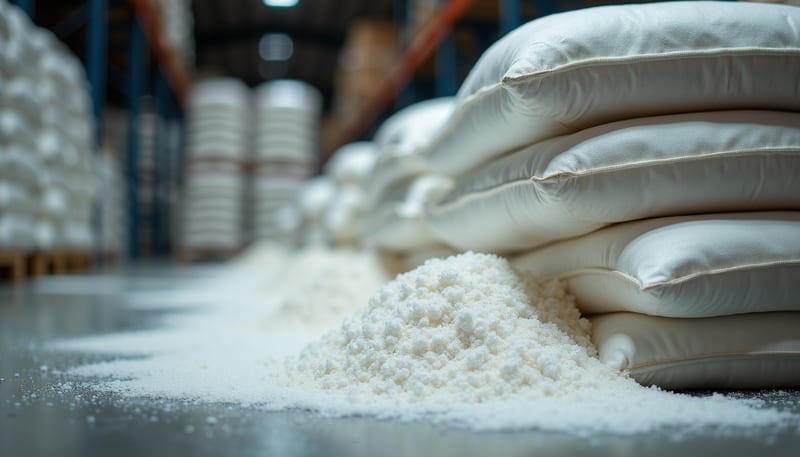
Container bulk — sugar packed in bags (50 kg polypropylene, 1 MT big bags, or loose-filled containers) and shipped in standard 20ft or 40ft dry containers. This is the standard unit for importers buying 25–500 MT per order.
| Container | Capacity (bagged) | Capacity (bulk-filled) |
|---|---|---|
| 20ft dry | ~25 MT in 50 kg bags | ~26 MT loose-filled with liner |
| 40ft dry | ~27 MT in 50 kg bags | ~28 MT loose-filled with liner |
Vessel bulk — raw sugar loaded directly into the hold of a dry-bulk vessel without individual packaging. Vessel lots start at approximately 12,500 MT (a Handysize charter) and run to 50,000 MT or more for Panamax-class vessels. This is the format used by refineries, national sugar importers and large trading houses.
For most importers buying finished sugar (ICUMSA 45, 35, 100 or crystal white), container shipments in bags are the standard format. For raw sugar destined for re-refining, vessel bulk is more economical at scale.
Types of bulk sugar available from Brazil
Brazil exports six principal ICUMSA grades. Each serves a different market:
| Grade | ICUMSA colour | Typical buyer | Detail page |
|---|---|---|---|
| ICUMSA 45 | ≤ 45 IU | Food manufacturers, bottlers, retailers, institutional buyers | View specifications → |
| ICUMSA 35 | ≤ 35 IU | Pharmaceutical, confectionery, markets requiring ultra-white sugar | View specifications → |
| Beverage-grade | ≤ 45 IU | Soft-drink bottlers and beverage manufacturers (tighter SO₂ and turbidity limits) | View specifications → |
| Crystal white | 100–150 IU | Retail and food-service markets (standard Brazilian table sugar) | View specifications → |
| ICUMSA 100 | ≤ 100 IU | Industrial food processing, bakery, plantation-white markets | View specifications → |
| Raw ICUMSA 600–1200 | 600–1200 IU | Refineries buying feedstock for re-refining; demerara/muscovado retail | View specifications → |
For the science behind these ratings — what ICUMSA measures, how the scale works and why a lower number means a higher premium — see our sugar grades and the ICUMSA scale reference page.
Packaging options for bulk sugar
The choice of packaging affects the unit cost, the handling at destination and the shelf life:
50 kg woven polypropylene bags
The default for international sugar trade. Double-stitched, with or without an inner polyethylene liner. Palletised for container loading. A 20ft container holds approximately 500 bags (25 MT); a 40ft container approximately 540 bags (27 MT).
Advantages: easy to handle with a forklift, standard across all ports, no specialist discharge equipment needed. Disadvantages: higher labour cost per ton at origin (filling, weighing, stitching, palletising).
1 MT FIBC (big bags / jumbo bags)
Flexible intermediate bulk containers, typically woven polypropylene with lift loops and a discharge spout. A 20ft container holds 20–24 big bags.
Advantages: faster loading and discharge than 50 kg bags, fewer units to handle. Disadvantages: requires a crane or forklift with a beam attachment at destination.
Bulk-filled container (with liner)
A container fitted with a food-grade polyethylene liner. Sugar is loaded directly into the liner, which is sealed. Capacity is marginally higher than bagged because no space is wasted on pallets and bag geometry.
Advantages: lowest packaging cost per ton for container shipments. Disadvantages: requires a tilting chassis or pneumatic discharge at destination.
Bulk vessel (hold loading)
Raw sugar for re-refining is typically shipped in bulk dry-cargo vessels. The holds are surveyed and cleaned before loading. An independent superintendent supervises loading and a certificate of weight is issued.
For a detailed look at container configurations, bag stacking patterns and shipping documentation, see our packaging guide.
How to evaluate a bulk sugar supplier
Not every company offering sugar online is a sugar supplier. The commodity attracts intermediaries, agents and, in some cases, fraudulent operators. Here is what to verify:
Documentation a real supplier provides
- ICUMSA certificate — an independent laboratory report certifying the sugar's colour, polarisation, moisture, ash and SO₂ content. It is issued per lot, not as a blanket claim.
- Certificate of origin — issued by a chamber of commerce (in Brazil, typically CCAB or a state federation of commerce) confirming the country of origin. Required for preferential tariff rates in many markets.
- Phytosanitary certificate — issued by Brazil's Ministry of Agriculture (MAPA) confirming the product is free from regulated pests and diseases. Required by most importing countries.
- Certificate of weight — issued by an independent superintendent (SGS, Bureau Veritas, Cotecna, Intertek) at the port of loading.
- Bill of lading — the shipping document that confirms the cargo has been loaded and serves as the title to the goods.
Red flags
- A "supplier" that cannot name the mill or refinery.
- Requests for upfront fees before any contract is signed.
- ICUMSA certificates without a laboratory name, accreditation number or lot reference.
- Pricing dramatically below the ICE No. 11 benchmark (physical sugar cannot be cheaper than the futures settlement — the premium is always positive for refined grades).
- Claims of unlimited stock or immediate availability of thousands of tons with no lead time.
For a full due-diligence checklist, see our guide on identifying reliable sugar suppliers.
The sourcing process: from enquiry to shipment
A standard sugar export transaction follows this sequence:
1. Enquiry
The buyer sends an enquiry specifying grade, quantity, packaging, Incoterms and destination port. The more specific the enquiry, the faster the response.
2. Quotation
The supplier issues a quotation (or a soft corporate offer — SCO) naming the price per metric ton, the grade specifications, the packaging, the Incoterms, the loading port, the payment terms and the validity period.
3. Purchase order
The buyer issues an irrevocable corporate purchase order (ICPO) accepting the terms, or the two sides negotiate until terms are agreed.
4. Contract
A formal sale-and-purchase contract is signed by both parties. It incorporates the agreed terms and names the governing law and the arbitration body (GAFTA, in most international sugar contracts).
5. Payment instrument
The buyer opens an irrevocable letter of credit (LC) through their bank, or remits advance payment (TT), depending on the agreed terms. The LC is the most common instrument in sugar trade because it protects both parties: the seller ships knowing the bank guarantees payment; the buyer pays knowing the bank checks the documents before releasing funds.
6. Production and loading
The sugar is produced or drawn from stock, quality-tested, packed and transported to the loading port. An independent superintendent supervises loading and issues certificates of weight and quality.
7. Shipment and documents
The shipping line issues the bill of lading. The seller presents the full document set (bill of lading, ICUMSA certificate, certificate of origin, phytosanitary certificate, commercial invoice, packing list) to the LC negotiating bank.
8. Arrival and discharge
The cargo arrives at the destination port. The buyer clears customs using the documents and the HS code classification for the grade purchased.
Why source sugar from Brazil?
Brazil is the world's largest sugar exporter. The Centre-South region alone — principally São Paulo, Minas Gerais, Goiás, Mato Grosso do Sul and Paraná — produces the majority of the country's output. Several structural factors make Brazil the default origin for bulk sugar:
- Scale — the Centre-South crush processes hundreds of millions of tons of sugarcane annually, producing an exportable surplus that no other origin matches.
- Logistics — the port of Santos is the largest sugar-exporting terminal in the world. Paranaguá, Maceió and Recife are secondary export ports.
- Harvest calendar — the Centre-South crush runs April–November, overlapping with the Northern Hemisphere inter-crop, when demand for Southern Hemisphere sugar is highest. See the sugarcane harvest calendar for the month-by-month timeline.
- Grade range — Brazilian mills and refineries produce every grade from raw VHP (Very High Pol) sugar through ICUMSA 600–1200, ICUMSA 100, crystal white, and refined white ICUMSA 45 and ICUMSA 35, all under one supply chain.
- Established trade infrastructure — GAFTA contract forms, ICE No. 11 pricing, well-understood Incoterms, the Receita Federal's Comex Stat export database, independent superintendence at every port.
How to buy sugar in bulk: what to include in your first enquiry
A complete first enquiry contains:
- Your company name and country — so the supplier can check import requirements for your market.
- ICUMSA grade — or a description of your end use, so the supplier can recommend the appropriate grade.
- Quantity — in metric tons. If you are unsure, state a range (e.g. "25–50 MT initial order, with potential for quarterly repeat").
- Packaging preference — 50 kg bags, 1 MT big bags, bulk-filled container, or vessel bulk.
- Incoterms — FOB Santos, CFR or CIF to your port. If unsure, ask for FOB and CFR quotes so you can compare.
- Destination port — the port where you will receive the cargo.
- Payment terms you can offer — LC at sight, LC 30/60/90 days, TT advance, or open to discussion.
With these details, a quotation — naming the price per metric ton, the full specifications and the estimated loading window — can typically be issued within one working day.
Wholesale sugar suppliers vs brokers vs trading houses
Understanding who you are dealing with matters:
| Type | What they do | What they control |
|---|---|---|
| Supplier / exporter | Sources from mills or refineries, holds or arranges stock, ships directly to the buyer. | Grade, quality, logistics, documentation. |
| Broker / agent | Introduces buyers to sellers for a commission. Does not take title to the goods. | The introduction only. |
| Trading house | Buys from producers and sells to end-buyers, taking title and often financing the cargo. | Price, logistics, credit; may blend origins. |
For a first-time buyer, dealing directly with a supplier or a trading house that takes title is simpler than working through a chain of brokers, because there is one counterparty, one contract and one accountability path.
Frequently asked questions about buying sugar in bulk
What is the minimum order quantity for bulk sugar?
The practical minimum for international container trade is one 20ft container — approximately 25 metric tons in 50 kg bags. Smaller quantities are rarely economical because the fixed costs (documentation, port handling, container freight) are spread over fewer tons.
How long does it take to ship sugar from Brazil?
Lead times depend on the destination. As a guide: Middle East (Jebel Ali, Jeddah) 25–35 days from Santos; West Africa (Lagos, Tema) 18–25 days; South-East Asia (Jakarta, Manila) 35–45 days; North Africa (Casablanca, Algiers) 15–22 days. These are ocean transit times; add 7–14 days for production, packing and port loading.
Can I order a sample before committing to a container?
Yes. A 1–5 kg sample of the specified grade can be couriered for inspection and laboratory testing before a purchase order is placed. The sample cost is typically absorbed into the first order.
What is the difference between ICUMSA 45 and ICUMSA 150?
The ICUMSA rating measures the colour of sugar in solution. ICUMSA 45 is highly refined — white, with ≥ 99.80% polarisation, ≤ 0.04% moisture and ≤ 20 mg/kg SO₂. ICUMSA 150 (crystal white) is less refined — off-white, with ≥ 99.50% polarisation and a colour range of 100–150 IU. ICUMSA 45 commands a higher price because the additional refining steps add cost and reduce yield. See the full comparison on our sugar grades page.
Do I need a special licence to import sugar?
Import requirements vary by country. Most markets require a phytosanitary import permit, a commercial import licence and a correct HS code declaration. Some countries (e.g. India, Indonesia, China) apply tariff-rate quotas or require specific import approvals. Check with your local customs authority or trade ministry before placing an order.
How is sugar priced for bulk orders?
Sugar is priced per metric ton, derived from the ICE No. 11 (raw) or ICE No. 5 (white) futures benchmark plus a physical premium that reflects the ICUMSA grade, the packaging, the Incoterms and the market conditions at the time of quotation. For a detailed explanation, see our guide on how Brazilian sugar is priced.