The price of Brazilian sugar is not a fixed number. It is the sum of a futures benchmark — the ICE No. 11 raw sugar contract, traded in New York in US cents per pound — plus a physical premium that depends on the ICUMSA grade, the packaging, the Incoterms, the contract volume and the time of year. A buyer asking "what is the price of ICUMSA 45 sugar per ton?" is really asking about that premium, because the futures price changes every trading session while the premium moves on slower supply-and-demand fundamentals. Physical ICUMSA 45 sugar from Brazil, FOB Santos, typically trades at a premium to the ICE No. 11 settlement. The exact figure is confirmed on quotation for each enquiry.
This guide explains every component that makes up a Brazilian sugar price, so that when you request a quotation you understand exactly what you are paying for.
What determines the price of Brazilian sugar?
Five factors combine to form the price a buyer pays:
- The ICE No. 11 futures settlement — the global raw sugar benchmark, denominated in US cents per pound (c/lb). Every physical sugar contract references it, directly or indirectly.
- The ICUMSA grade premium — lower ICUMSA ratings mean higher refinement, which means higher cost. ICUMSA 45 commands the highest premium; raw sugar ICUMSA 600–1200 trades closest to the ICE No. 11 settlement.
- Incoterms — FOB (Free on Board) Santos is the baseline. CFR (Cost and Freight) and CIF (Cost, Insurance and Freight) add ocean freight and, in the CIF case, marine cargo insurance to the seller's side.
- Volume and packaging — a full 40ft container (~27 MT in 50 kg bags) offers a lower per-ton cost than partial loads. Bulk vessel shipments of 12,500 MT or more carry further economies.
- Seasonality — prices tend to ease during the Centre-South crush (April–November) when supply peaks, and firm during the inter-crop period (December–March).
ICE No. 11: the benchmark every physical sugar contract starts from
The ICE No. 11 contract is the world's most-traded sugar future. It settles in US cents per pound and represents raw cane sugar for physical delivery. One contract is 112,000 pounds (roughly 50.8 metric tons). The front-month settlement is what newspapers quote as "the sugar price", but a physical buyer does not trade futures — they trade the physical premium on top of them.
The ICE No. 11 contract trades on the Intercontinental Exchange (ICE) and is the reference for roughly 80% of global sugar traded by value. Brazil is the residual supplier to the world market, so Brazilian harvest expectations move the ICE No. 11 curve more than any other single factor.
Key point for buyers: the ICE No. 11 price is for raw, unrefined sugar delivered to one of five nominated ports. Refined white sugar — ICUMSA 45, ICUMSA 35, ICUMSA 100 — trades at a premium to this benchmark because refining costs are embedded.
The ICE No. 5, traded in London in US dollars per metric ton, is the white sugar benchmark. White sugar physical contracts may reference No. 5 instead of No. 11. The difference between No. 5 and No. 11 — called the white premium — is itself a traded spread.
ICUMSA 45 sugar price per ton — what shapes the premium
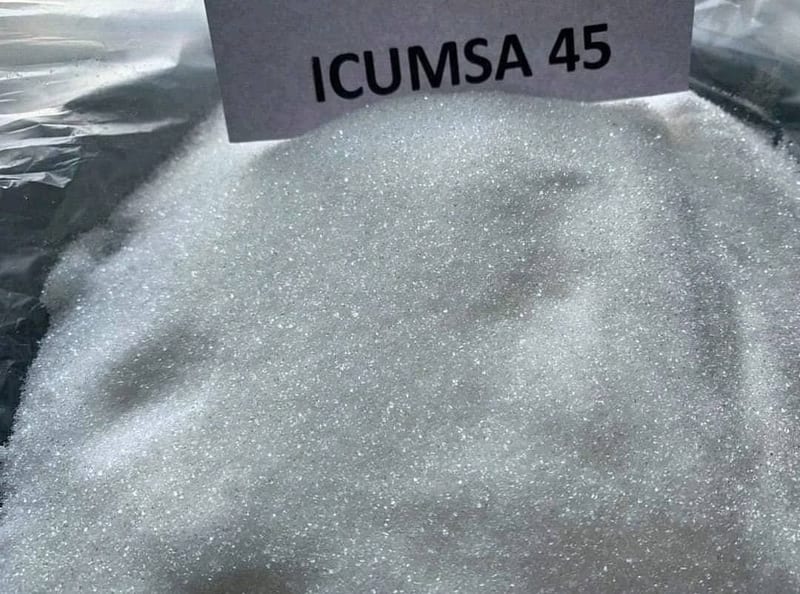
ICUMSA 45 sugar is the most refined grade in international trade: ≤ 45 ICUMSA colour units, ≥ 99.80% polarisation, ≤ 0.04% moisture, ≤ 0.04% ash. The cost of achieving those specifications is what drives its premium above lower grades.
The ICUMSA 45 premium over raw sugar reflects:
- Refining cost — crystallisation, affination, decolourisation and drying to reach ≤ 45 colour units.
- Yield loss — refining 100 MT of raw cane yields less than 100 MT of ICUMSA 45 product; the loss is embedded in the price.
- Certification cost — an independent ICUMSA certificate, phytosanitary certificate and certificate of origin are issued per shipment.
- Packaging — refined sugar for retail or food-industry use is packed in 50 kg woven polypropylene bags, 1 MT FIBC (big bags) or lined containers. Raw sugar for re-refining may ship in bulk vessels without individual packaging.
- Demand concentration — ICUMSA 45 is the grade specified by food manufacturers, bottlers, confectioners and institutional buyers worldwide. The Middle East, North Africa, South-East Asia and West Africa import the largest volumes.
For a current ICUMSA 45 price, request a quotation with your required volume, Incoterms and destination port.
How Incoterms change the delivered cost
The same sugar at the same moment has a different price depending on the Incoterms the contract specifies:
| Incoterm | What the seller pays | What the buyer pays | Typical use |
|---|---|---|---|
| FOB Santos | Production, inland transport, port loading | Ocean freight, insurance, discharge, customs | Standard for Brazilian sugar |
| CFR (destination) | All of FOB + ocean freight to the named port | Insurance, discharge, customs | Common for Middle East / North Africa |
| CIF (destination) | All of CFR + marine cargo insurance | Discharge, customs | Common for West Africa / South-East Asia |
FOB Santos is the most-quoted basis because it isolates the sugar cost from the freight cost, making prices comparable across origins. A CFR or CIF quote will always be higher because it bundles freight (and insurance) into the seller's price.
The port of Santos (São Paulo state) handles the majority of Brazil's sugar exports. Paranaguá (Paraná) and Maceió (Alagoas) are secondary ports. The choice of loading port can affect the basis by a few dollars per ton depending on hinterland logistics.
Seasonal pricing patterns in the Brazilian sugar market
Brazil's Centre-South region — São Paulo, Minas Gerais, Goiás, Mato Grosso do Sul, Paraná — produces roughly 90% of the country's sugar. The crush season runs from April through November, peaking in July–September.
| Period | Supply dynamic | Price tendency |
|---|---|---|
| April–June | Crush begins; fresh supply enters the market | Prices ease as availability rises |
| July–September | Peak crush; mills maximise throughput | Supply is at its highest; prices typically at seasonal lows |
| October–November | Crush winds down; carry-over stocks firm | Prices begin to recover |
| December–March | Inter-crop; no fresh milling; stocks draw down | Prices tend to firm; availability is tightest |
These are tendencies, not certainties. Global inventory levels, the ethanol parity (mills can divert cane to ethanol when it is more profitable), the BRL/USD exchange rate, and weather events (frost in Paraná, drought in São Paulo) all override seasonal patterns in individual years.
Buyers who plan annual procurement can use the harvest calendar to time enquiries when supply is most abundant.
Why online sugar prices are misleading
A search for "sugar price today" returns the ICE No. 11 futures settlement — a raw-sugar benchmark denominated in cents per pound. Translating that number into a physical delivered cost requires several adjustments:
- Unit conversion — ICE No. 11 is in US cents per pound. One metric ton = 2,204.62 pounds. Multiply the c/lb figure by 22.0462 to get a rough $/MT equivalent for raw sugar.
- The physical premium — nobody sells physical sugar at the futures settlement. The premium (or discount, in a surplus) reflects grade, origin, quality and logistics.
- The white premium — refined sugar (ICUMSA 45, 35, 100) trades above raw. The white premium varies independently of the raw-sugar benchmark.
- Freight — a FOB price becomes a CFR or CIF price once freight is added. Container freight rates from Santos to the Arabian Gulf, for instance, vary with global shipping capacity.
- Currency — Brazilian production costs are in BRL; international trade settles in USD. A weaker real lowers the cost floor for Brazilian sellers, which tends to push export prices down.
The figure on a commodity ticker is not the price you will pay. It is the starting point of a calculation. The premium, the Incoterms, the packaging and the volume are where the negotiation happens.
Sugar wholesale price vs spot price vs contract price
| Type | Definition | Who uses it |
|---|---|---|
| Spot price | Price for immediate or near-term delivery, often a single cargo. Reflects current supply-demand balance. | Traders filling short-term gaps |
| Contract price | Price agreed for delivery over a period (quarterly, semi-annual, annual). Often formula-based: ICE No. 11 + agreed premium. | Food manufacturers, institutional buyers, importers with steady demand |
| Wholesale price | A general term for bulk quantities. In practice, both spot and contract prices are wholesale — retail pricing is a different market entirely. | — |
For a new buyer, the practical starting point is a spot enquiry: one shipment, one grade, one delivery. Once a relationship is established and demand is predictable, a contract structure (e.g. quarterly shipments at ICE No. 11 + fixed premium) reduces price volatility for both sides.
How to get a real sugar price quote
A supplier cannot give a meaningful price without five pieces of information:
- ICUMSA grade — ICUMSA 45, ICUMSA 35, ICUMSA 100, crystal white, raw ICUMSA 600–1200, or beverage-grade.
- Quantity — in metric tons. A 20ft container holds approximately 25 MT in bags; a 40ft container approximately 27 MT.
- Incoterms — FOB Santos, CFR or CIF to your port.
- Destination port — freight cost depends on the route.
- Packaging — 50 kg bags, 1 MT big bags, or bulk.
With those five details, a quotation can be issued within one working day. The price is valid for a stated period (typically 3–7 days) because the underlying futures benchmark moves daily.
To begin, send an enquiry or call us on +55 61 2017 3509. Include the five details above and you will receive a detailed quotation naming the grade specifications, the price per metric ton, the Incoterms, the payment terms and the estimated loading date.
For the documentation that follows a quotation — the soft corporate offer (SCO), the irrevocable corporate purchase order (ICPO) and the full contract sequence — we have a separate guide. For customs classification under HS heading 1701, including which subheading each Brazilian grade falls under, see our HS code explainer.
Pricing by ICUMSA grade
The table below lists every grade we supply, ordered from highest premium (most refined) to lowest. Exact pricing is confirmed on quotation.
| Grade | ICUMSA colour | Polarisation | Typical premium position | Detail page |
|---|---|---|---|---|
| ICUMSA 45 | ≤ 45 IU | ≥ 99.80°Z | Highest — most refined, widest demand | View specifications → |
| ICUMSA 35 | ≤ 35 IU | ≥ 99.80°Z | Above ICUMSA 45 in some markets (tighter spec) | View specifications → |
| Beverage-grade | ≤ 45 IU | ≥ 99.80°Z | Similar to ICUMSA 45; narrower SO₂ and turbidity limits | View specifications → |
| Crystal white | 100–150 IU | ≥ 99.50°Z | Mid-range — standard table sugar in Brazil | View specifications → |
| ICUMSA 100 | ≤ 100 IU | ≥ 99.50°Z | Mid-range — plantation white / mill white | View specifications → |
| Raw ICUMSA 600–1200 | 600–1200 IU | ≥ 96.00°Z | Lowest — closest to ICE No. 11 settlement | View specifications → |
For the full ICUMSA scale and what each rating measures, see our sugar grades reference.
Frequently asked questions about Brazil sugar prices
What is the current price of ICUMSA 45 sugar per ton?
The price of ICUMSA 45 sugar from Brazil changes daily because it is derived from the ICE No. 11 futures settlement plus a physical premium. The premium itself varies with season, volume, packaging and Incoterms. There is no single fixed price — it is confirmed on quotation for each enquiry. Request a quote →
Is Brazilian sugar cheaper during harvest season?
Generally yes. The Centre-South crush runs from April to November, and supply peaks in July–September. When mill output is at its highest, physical premiums tend to compress. The inter-crop period (December–March) typically sees firmer prices as stocks draw down. However, the ICE No. 11 futures price, the BRL/USD rate and global demand all interact, so the seasonal pattern is a tendency rather than a rule.
Why is ICUMSA 45 more expensive than raw sugar?
Because it is more refined. Achieving ≤ 45 ICUMSA colour units, ≥ 99.80% polarisation and ≤ 0.04% moisture requires additional refining steps — affination, decolourisation, crystallisation and drying — each of which adds cost and reduces yield. A refinery processing 100 MT of raw cane produces fewer than 100 MT of ICUMSA 45 product, and that yield loss is embedded in the price.
How much sugar fits in a container?
A standard 20ft dry container holds approximately 25 metric tons in 50 kg bags. A 40ft container holds approximately 27 metric tons. For bulk vessel shipments (12,500 MT and above), contact us for a vessel-lot quotation. For more on packaging options and container configurations, see our packaging guide.
What payment terms are standard for Brazilian sugar exports?
The most common instrument is an irrevocable letter of credit (LC) confirmed by a first-class international bank, payable at sight or with a usance period (typically 30, 60 or 90 days from bill of lading date). Advance payment (TT) and documentary collection (D/P, D/A) are also used depending on the relationship and the jurisdiction. Terms are agreed during the contract stage after the SCO/ICPO exchange.