Importing sugar is not complicated, but it is document-heavy. A single shipment of Brazilian sugar can involve twelve or more documents — from the commercial invoice and bill of lading to the phytosanitary certificate and certificate of origin — and the tariff treatment depends on the HS code, the origin country and any preferential trade agreement the destination has in force. This guide walks through the documents, the tariffs and the process, so that a first-time importer knows what to prepare and an experienced one has a checklist to work from.
Before the shipment: what to have in place
Three things must exist before a sugar import can clear customs at destination:
-
An import licence or registration. Most countries require food importers to be registered with the national food-safety authority or the customs administration, or both. In many markets this is a standing registration, not a per-shipment licence. In others — Nigeria, for example — a per-consignment import permit is required.
-
A confirmed supplier and contract. The contract should state the sugar grade, quantity, price, Incoterm, packaging, shipment window and the documents the supplier will provide. The document list in the contract should match what the destination customs authority requires; if the buyer does not specify, the supplier will issue the standard set, which may not include market-specific documents the buyer's customs needs.
-
A customs broker or clearing agent at the destination port. Sugar is classified under HS heading 1701 and may be subject to tariff-rate quotas, anti-dumping duties or preferential rates depending on origin. A broker who handles food commodities will know the local requirements.
The documents that travel with a sugar shipment
The table below lists the documents that accompany a typical containerised sugar shipment from Brazil to a foreign port. Not every destination requires every document, and some destinations require additional ones (halal certificates, radiation-free certificates, age-of-sugar declarations). The buyer should state the full document list in the contract.
| Document | Issued by | Purpose | Notes |
|---|---|---|---|
| Commercial invoice | Seller | States the goods, quantity, unit price, total value, Incoterm and payment terms | Must match the bill of lading and the customs declaration |
| Packing list | Seller | States the number of bags, net and gross weight per container, and the shipper's marks | Weight figures must reconcile with the bill of lading |
| Bill of lading (B/L) | Shipping line or freight forwarder | Title document; proves the goods are on board the vessel | Original B/L needed for release at destination unless the buyer uses a telex release or sea waybill |
| Certificate of origin (CO) | Chamber of commerce or trade authority at origin | Proves the goods originate in Brazil | Required for preferential tariff rates under trade agreements (Mercosur, GSP) and for some countries unconditionally |
| Phytosanitary certificate | MAPA (Brazil's Ministry of Agriculture) | Confirms the sugar is free of quarantine pests and meets the phytosanitary requirements of the destination | Issued after inspection at the port of loading |
| Certificate of analysis (COA) | Independent surveyor or the mill's laboratory | States the sugar's quality parameters: polarisation, colour (ICUMSA), moisture, ash, SO₂, granulation, heavy metals | The COA is the buyer's evidence that the sugar meets the contracted specification |
| Certificate of weight | Independent surveyor at the port of loading | States the weight loaded into each container or vessel hold | Settles weight disputes; often issued by the same surveyor who issues the COA |
| Fumigation certificate | Fumigation company | Confirms the containers or holds were fumigated against insects before or after loading | Required by many African, Middle Eastern and Asian destinations |
| Health / sanitary certificate | Health authority at origin (Vigilância Sanitária in Brazil) | Confirms the product is fit for human consumption | Not the same as the phytosanitary certificate; some destinations require both |
| Insurance certificate | Insurance company | Confirms marine cargo insurance is in force | Required when the Incoterm is CIF or CIP; the buyer arranges insurance under FOB or CFR |
| Food-grade packaging declaration | Packaging manufacturer | Confirms the bag liner is food-grade polyethylene per the applicable regulation (EU 1935/2004 or FDA 21 CFR 177.1520) | The buyer should state which regulation applies |
| Certificate of conformity or pre-shipment inspection | Inspection company (SGS, Bureau Veritas, Intertek, etc.) | Confirms the goods conform to the destination country's import standards | Required by some African countries under their conformity assessment programmes (PVOC, SONCAP, CoC) |
A buyer who is importing sugar for the first time should request a sample document set from the supplier before contracting, so that the buyer's customs broker can confirm the documents will clear the shipment.
How sugar import tariffs work
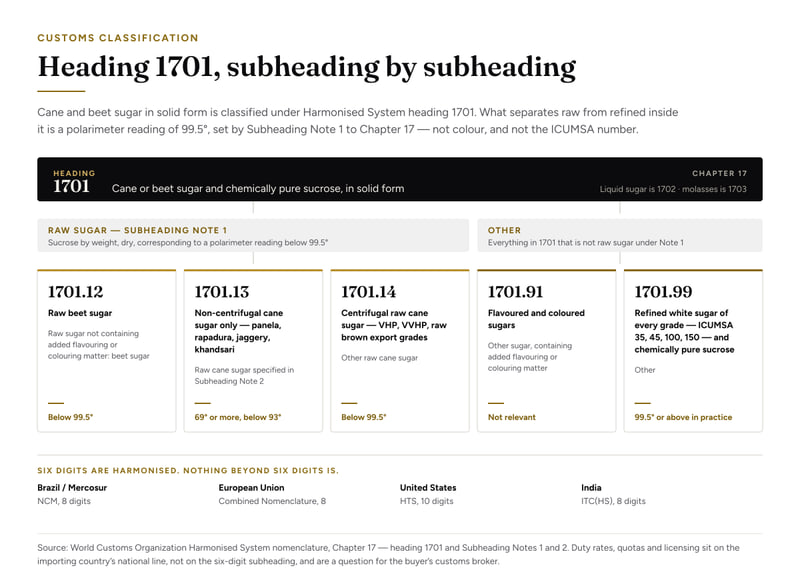
Sugar tariffs are structured around HS heading 1701. The heading splits at the six-digit level by raw versus refined and by cane versus beet. The destination country adds its own digits and its own duty rate.
Three tariff mechanisms apply to sugar in most markets:
Ad valorem duty. A percentage of the CIF value. Common in markets without a domestic sugar industry to protect.
Specific duty. A fixed amount per tonne or per kilogram. Common in markets that want a predictable price floor for domestic producers. The EU, for example, applies a specific duty of EUR 419 per tonne on out-of-quota white sugar.
Tariff-rate quota (TRQ). A two-tier system: a low or zero duty applies to imports within the quota, and a higher duty applies above it. The United States uses TRQs for raw and refined sugar, with in-quota rates near zero and over-quota rates that are effectively prohibitive.
The applicable rate depends on three variables:
- The HS subheading — raw cane (1701.14), raw beet (1701.12), refined (1701.99) and others each carry different rates.
- The origin country — preferential trade agreements (GSP, Mercosur, CPTPP, African Union, ASEAN, bilateral FTAs) may reduce or eliminate the duty for sugar from qualifying origins.
- The quota status — for markets with TRQs, whether the shipment falls within or outside the quota allocation.
Tariff rates by major importing region
The rates below are representative and change with trade policy. A buyer should confirm the applicable rate with a customs broker before contracting.
| Market | Raw sugar (1701.14) | Refined sugar (1701.99) | Notes |
|---|---|---|---|
| United States | 0.625 cents/lb in-quota; 15.36 cents/lb over-quota | 3.6606 cents/lb in-quota; 17.0 cents/lb over-quota | TRQ system; Brazil has a country allocation |
| European Union | EUR 339/tonne out-of-quota | EUR 419/tonne out-of-quota | EPA and EBA agreements give duty-free access to ACP and LDC origins; Brazil pays the full rate |
| China | 15% in-quota; 50% over-quota | 15% in-quota; 50% over-quota | TRQ of 1.945 million tonnes; automatic allocation |
| India | 100% basic customs duty | 100% basic customs duty | Effectively prohibitive; India is a net exporter in most years |
| GCC (Gulf states) | 5% | 5% | Uniform GCC Common External Tariff |
| Nigeria | 10% duty + 60% sugar levy | 20% duty + 60% sugar levy | The levy is the binding constraint; administered by the National Sugar Development Council |
| Indonesia | IDR 790/kg (raw) | IDR 990/kg (refined) | Specific duty; subject to periodic revision |
These rates determine the landed cost and therefore the competitiveness of Brazilian sugar in a given market. A buyer comparing Brazilian sugar to sugar from a preferential origin (a GSP-eligible LDC, for example) should factor the tariff differential into the total cost.
Phytosanitary and food-safety clearance
Sugar is a processed agricultural product. Most destination countries require two kinds of clearance:
Phytosanitary clearance confirms the product does not carry quarantine pests. Brazil's phytosanitary certificates are issued by MAPA (Ministério da Agricultura, Pecuária e Abastecimento) after an inspection at the port of loading. The certificate names the product, the quantity, the destination country and the specific phytosanitary requirements of that country as declared in the buyer's import permit or the destination's IPPC submission.
Food-safety clearance confirms the product is fit for human consumption and meets the destination's food-safety standards. This typically involves:
- A certificate of analysis (COA) showing the sugar meets the contracted specification, including heavy-metal limits, SO₂ levels and microbiological parameters where required.
- A health certificate from the origin country's health authority.
- In some markets, a pre-shipment inspection by an accredited inspection body (SGS, Bureau Veritas, Intertek) under the destination country's conformity assessment programme.
The buyer's customs broker or clearing agent will know which certificates the destination port requires. The time to ask is before the contract is signed, not after the container is on the water.
The import process, step by step
The sequence below assumes a containerised FOB shipment of refined sugar from Santos, Brazil to a foreign port. Bulk vessel shipments follow the same document flow but involve additional logistics (vessel nomination, laycan, demurrage).
1. Enquiry and quotation
The buyer sends an enquiry stating grade, quantity, packaging, Incoterm and destination. The supplier responds with a quotation and, if requested, a sample certificate of analysis from a recent production lot.
2. Contract
The buyer and supplier agree on a contract (or a Soft Corporate Offer followed by a full contract) that states the product specification, price, shipment window, payment terms, documents to be provided and any penalty or arbitration clauses. For the role of SCOs and ICPOs in sugar trade, see the dedicated page.
3. Payment instrument
The buyer opens a letter of credit (L/C) through their bank, or arranges the agreed payment method (CAD, TT advance, etc.). For L/C shipments, the L/C terms must match the contract exactly — including the document list, the shipping deadline and the tolerance on quantity. A discrepancy between the L/C and the documents is the most common cause of payment delay in the sugar trade.
4. Production and packing
The supplier arranges production, quality control, packing and container stuffing. The independent surveyor attends the stuffing to issue the certificate of weight and the certificate of analysis.
5. Shipping
The containers are delivered to the port, loaded onto the vessel and the bill of lading is issued. The phytosanitary certificate is issued by MAPA after the port inspection.
6. Document presentation
The supplier presents the full document set — commercial invoice, packing list, bill of lading, COA, CO, phytosanitary certificate and any other documents required by the contract — to the buyer or to the buyer's bank (for L/C shipments).
7. Arrival and customs clearance
The containers arrive at the destination port. The buyer's customs broker files the import declaration, presenting the documents and paying the applicable duty. Customs may inspect the cargo (document check, physical inspection, or both).
8. Phytosanitary and food-safety inspection
The destination country's agriculture or food-safety authority may take samples from the shipment for laboratory analysis. This can add days to the clearance process, depending on the country and the inspection regime.
9. Release and delivery
Once customs and any regulatory authorities release the cargo, the containers are delivered to the buyer's warehouse or directly to the end user.
Common mistakes that delay sugar imports
These are the problems that customs brokers see repeatedly, and every one of them is avoidable by getting the document list right before shipment.
Wrong or missing HS code. The commercial invoice states "sugar" without the six-digit HS subheading, or states the wrong subheading. Customs cannot assess the duty without the correct code, and the importer cannot claim a preferential rate without the code that matches the certificate of origin. The HS code guide explains the classification.
Certificate of origin does not match the L/C. The L/C requires a certificate of origin issued by the Brazilian chamber of commerce, and the supplier presents one issued by MAPA, or vice versa. The bank rejects the documents, and the buyer cannot take delivery until a replacement is issued.
Phytosanitary certificate names the wrong destination. The certificate must name the actual destination country. A certificate that names a transit country, or that names no destination, will be rejected at the destination port.
Packaging does not match the destination's food-contact regulation. The contract does not specify which food-contact regulation the packaging must comply with. The supplier uses a liner that meets Brazilian standards but not the destination's EU or FDA standard. The food-safety authority at destination holds the cargo until a declaration of compliance is produced.
Weight discrepancy. The bill of lading, the commercial invoice and the certificate of weight state different weights. Any discrepancy — even a rounding difference — triggers a customs query and may trigger a penalty.
No fumigation certificate. Many African and Middle Eastern destinations require proof of fumigation. If the contract does not specify it, the supplier may not arrange it, and the cargo is held at destination until fumigation is performed there — at the buyer's cost, with the sugar sitting in the port.
Importing sugar from Brazil specifically
Brazil is the world's largest sugar exporter. A few specifics apply to Brazilian-origin sugar:
- Phytosanitary authority: MAPA. All phytosanitary certificates for agricultural exports are issued by MAPA inspectors at the port of loading.
- Certificate of origin: issued by a local chamber of commerce (for non-preferential CO) or by the relevant authority under Mercosur's preferential rules of origin.
- Currency: Brazilian sugar is quoted in US dollars, and contracts are denominated in USD. The FOB price is in USD per metric tonne.
- Incoterms: FOB Santos and FOB Paranaguá are the most common for containerised sugar. CFR and CIF are available; the supplier arranges freight and, for CIF, insurance.
- Crushing season: The Centre-South season runs April to November. Sugar produced during the season is available for shipment throughout the year from warehouse stocks, but freshly produced sugar is most available during and immediately after the crush.
- Quality standards: Brazilian sugar quality is governed by MAPA regulations and by the mill's own quality management system. International buyers typically rely on the certificate of analysis issued by an independent surveyor (SGS, Bureau Veritas, Intertek, Control Union) rather than the mill certificate.
How to start an enquiry
To request a quotation for Brazilian sugar — whether ICUMSA 45, ICUMSA 100, crystal white, raw brown or VHP — send your enquiry to our contact page with the grade, quantity, destination port and preferred Incoterm. A quotation with the applicable specification and a sample document list will be provided.
Sources
- World Customs Organization, Harmonised System Nomenclature 2022, Chapter 17.
- United States International Trade Commission, Harmonized Tariff Schedule, Chapter 17.
- European Commission, TARIC database, CN codes 1701 12 through 1701 99.
- MAPA (Ministério da Agricultura, Pecuária e Abastecimento), phytosanitary export requirements.
- International Sugar Organization, Sugar Year Book 2025.