Every export sugar cargo is checked by an independent inspection company at loading, and the results travel as certificates that the buyer and the banks rely on. The key ones are the certificate of analysis (what the sugar is), the weight and quality certificates (how much was loaded and in what condition), the phytosanitary certificate (plant health, where the importing country requires it) and the certificate of origin. This guide explains what an SGS-type inspection actually does, what each certificate must state, who issues it in Brazil, and how to write inspection into your contract.
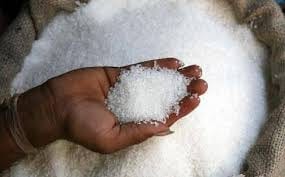
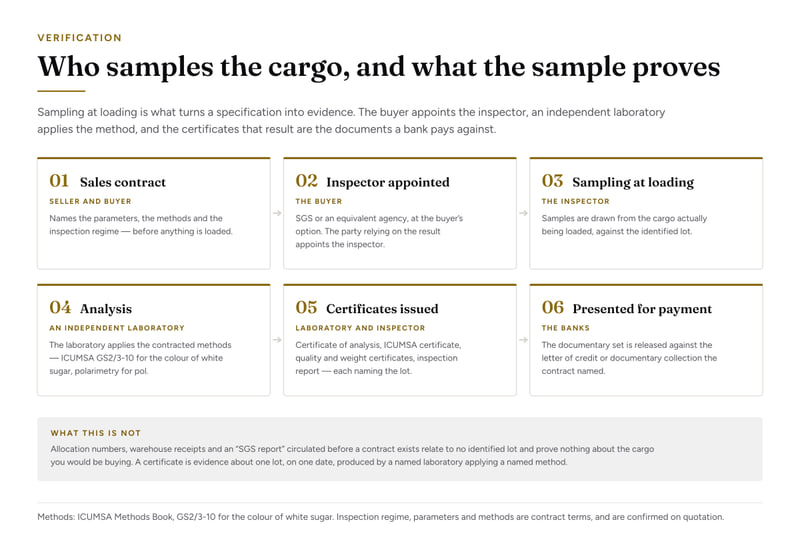
Samples are drawn from the lot during loading and tested in a laboratory against the contract specification
Who inspects export sugar?
Independent inspection and testing companies, often called surveyors. SGS is the best known, which is why buyers often say "SGS inspection" for any third-party inspection. Intertek, Bureau Veritas, Cotecna and other agencies do the same work at Brazilian ports. What matters is not the brand but that:
- the agency is named in the contract and the letter of credit;
- it is independent of the seller, and ideally appointed or approved by the buyer;
- it tests by the methods the contract specifies, normally ICUMSA methods.
What a pre-shipment sugar inspection covers
| Stage | What the inspector does |
|---|---|
| Before loading | Checks the warehouse, the condition of bags, the cleanliness and dryness of containers or ship's holds |
| Sampling | Draws samples continuously or at set intervals during loading, to make one representative composite sample per lot |
| Laboratory analysis | Tests the sample: colour (ICUMSA), polarisation or sucrose, moisture, ash, and any other parameter in the contract |
| Weight | Bag counts and check-weighing for bagged sugar; draft survey or scale weights for bulk |
| Loading supervision | Watches stowage, notes rain stoppages, seals containers and records seal numbers |
| Certification | Issues the certificates the contract and LC require |
The sample is usually split into several sealed portions: one for the analysis, and retained samples for the buyer, the seller and any later dispute. The inspection chain explained in our SCO and ICPO guide shows how this fits into a genuine sale.
The certificates, one by one
Certificate of analysis (COA)
The COA states what the sugar is. For a refined grade such as ICUMSA 45 it should list at least:
- colour in ICUMSA units (IU) and the ICUMSA method used;
- polarisation or sucrose content;
- moisture, ash (conductivity), and often solubility, sediment, SO₂, granulation and microbiology if the contract asks;
- the lot, quantity, vessel or container numbers, sampling dates and place;
- the issuer, signature and date.
A COA is a statement about one lot. A generic "product specification sheet" is not a certificate of analysis, and a COA from a previous cargo proves nothing about yours.
ICUMSA colour certificate
Some buyers and letters of credit ask for a separate certificate stating only the ICUMSA colour. It is normally issued by the same inspector or laboratory. ICUMSA itself does not certify sellers or cargoes; it publishes methods. See what is ICUMSA.
Weight certificate and quality certificate
The weight certificate records the quantity loaded, and the quality certificate confirms the sugar met the contract specification at loading. Under most contracts the loading results are final for quality and weight, which is why the choice of inspector matters.
Phytosanitary certificate
A phytosanitary certificate confirms that the consignment was inspected and is free from regulated pests under the importing country's rules. Many countries do not require one for refined sugar, which is a processed product, but some require it for raw sugar or for all sugar. In Brazil it is issued by the Ministry of Agriculture and Livestock (MAPA), Brazil's national plant-protection organisation, under the international IPPC framework. Your import permit or customs broker will tell you whether you need one.
Certificate of origin
The certificate of origin states that the sugar is Brazilian. In Brazil it is issued by entities accredited by SECEX, the Foreign Trade Secretariat. Some markets require a specific form to claim preferential tariffs. Documents for many Arab markets are also legalised through the Arab-Brazilian Chamber of Commerce.
Fumigation certificate
Required by some importing countries for bagged cargo or wooden pallets. Pallets themselves should carry the ISPM 15 heat-treatment mark.
Other shipping documents
Commercial invoice, packing list, bill of lading, and on CIF terms the insurance certificate. The full set and customs steps are covered in how to import sugar.
Who pays for inspection?
The contract decides. A common arrangement is that the seller pays for loading inspection by an agency the buyer accepts, and the buyer pays for any additional inspection it wants, including at destination. Get it in writing, together with the methods and whether loading results are final.
How to write inspection into a sugar contract
- Name the agency and the place: "Inspection at loading by SGS (or Intertek) at the port of Santos."
- List the parameters and limits: "Colour max. 45 IU (ICUMSA GS2/3-10); polarisation min. 99.80°Z; moisture max. 0.04%..."
- State finality: whether the loading certificates are final for quality and weight.
- Specify the certificates you need for customs and the LC, with exact titles.
- Retain samples: how many sealed samples, who keeps them and for how long.
- Dispute route: an umpire laboratory or arbitration rules if results are disputed.
Red flags in inspection documents
- A "SGS report" offered before a contract or shipment exists, sometimes as "proof of product".
- A COA with no lot, vessel or container numbers.
- Certificates whose reference numbers cannot be verified with the issuing office. Inspection companies can confirm whether a certificate is genuine; contact them through their official website, not a number on the document.
- A request for a fee to "release" inspection reports.
What we provide
On every shipment we quote, we name the inspection agency, the specification and the certificates on the quotation, and the buyer may appoint its own inspector at loading. Ask for a quotation and specification.
Frequently asked questions
What is SGS inspection for sugar? An independent pre-shipment inspection in which SGS, or a similar agency, samples the sugar during loading, tests it in a laboratory and issues certificates of quality and weight.
What is a certificate of analysis for sugar? A lot-specific laboratory report stating the measured colour, polarisation or sucrose, moisture, ash and other parameters of the cargo.
Do I need a phytosanitary certificate for sugar? It depends on the importing country and the grade. Some require one for raw sugar or all sugar; many do not for refined sugar. Check your import permit.
Who issues the phytosanitary certificate in Brazil? The Ministry of Agriculture and Livestock (MAPA).
Are the loading inspection results final? Only if the contract says so. Most sugar contracts make the loading certificates final for quality and weight.
Can a supplier be "ICUMSA certified"? No. ICUMSA publishes analysis methods; it does not certify companies. Ask instead for a certificate of analysis for your lot, tested by ICUMSA methods.