"Best" is not a property of a supplier. It is a property of the match between a supplier and what you are buying it for. A beverage bottler, a confectioner, a repacker and a refinery each need a different thing from a Brazilian sugar supplier, and a company that is ideal for one is a poor fit for another. This page sets out four buyer profiles and what each should actually prioritise — so that "best" becomes a decision you can make rather than a claim you have to trust.
Understanding the Sugar Industry in Brazil
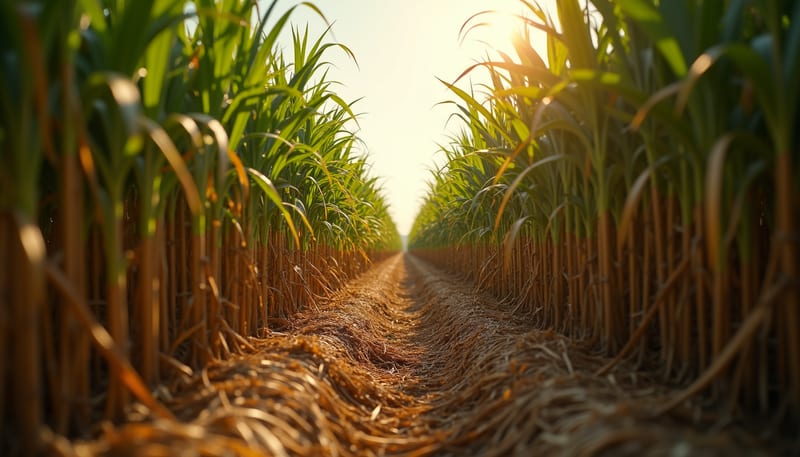
Brazil is the world's largest sugar exporter, and it can supply the whole ICUMSA range from raw to highly refined. Production is clustered around mills rather than centralised, because cut cane cannot travel far, and most Brazilian mills are paired with a distillery, so supply responds to the sugar–ethanol economics rather than sitting fixed.
What that means for a buyer is that the constraint is almost never whether Brazil can produce what you need. It is whether the counterparty in front of you is built to sell it to you, in your unit, on your terms, with your documents. The six links in the Brazilian export chain explains who is built for what.
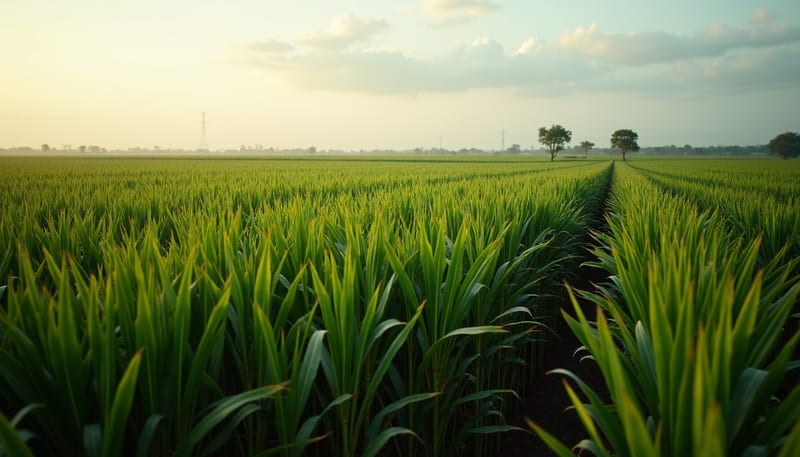
Sugarcane plantation in Brazil
Top Sugar Suppliers Brazil: Key Players to Know
The honest version of this section is a warning rather than a list.
Supplier rankings for Brazilian sugar circulate widely, and they share three defects: the volume figures are unattributed, they disagree with each other, and several of the companies named most often have since been acquired or restructured out of existence. A list like that cannot tell you who is best, because it is not measuring anything, and it certainly cannot tell you who is best for you. We have chosen not to publish one. What is actually checkable about Brazil's major producers is a more useful page than a league table.
What you can do instead is identify your own profile below, and then test any supplier — including this one — against the criteria that profile needs. If you want the producer names anyway, with the commercial qualification that matters, the top sugar exporters in Brazil, and what each will actually sell you is the better page for it.
Profile 1: the beverage bottler or syrup house
What you need: consistent low colour, consistent granulation and dissolution behaviour, and microbiological control. Floc in a clear carbonated drink is a product recall, not a quality complaint.
Prioritise: specification consistency between lots over the headline figure; a certificate of analysis for every lot; an inspection agency named in the contract; a supplier who can hold a standing allocation rather than a spot cargo. Start from beverage grade refined cane sugar or ICUMSA 45.
Deprioritise: the last few points of price. The cost of a non-conforming lot dwarfs the differential.
Profile 2: the food and confectionery manufacturer
What you need: the right crystal size for your process, reliable moisture control, and packaging that suits your handling.
Prioritise: granulation specified separately from colour — they are set at different points on the line, as the production line explains — and a supplier who will discuss bag format, jumbo bags and palletisation rather than quoting one default. ICUMSA 45 and refined white sugar crystals are the usual starting points.
Deprioritise: chasing the lowest ICUMSA number available. Paying for refining passes your product does not need is the most common avoidable cost in this trade.
Profile 3: the importer, distributor or repacker
What you need: landed cost, documentation that clears customs first time, and continuity of supply so your own customers are not disappointed.
Prioritise: the document set — certificate of origin from an accredited certifier, certificate of analysis, ICUMSA certificate, weight and quality certificates. For Arab-League destinations the preferential certificate of origin determines the tariff you pay, so it is a line in your landed cost. Prioritise a counterparty that is the exporter of record and can say which legal entity will invoice you.
Deprioritise: mill-direct romance. A mill group will not serve a container programme; an export trading house is built for it.
Profile 4: the refinery, distillery or fermentation plant
What you need: raw sugar at a predictable polarisation, in volume, at the lowest delivered cost per unit of recoverable sucrose.
Prioritise: raw brown cane sugar, ICUMSA 600–1200 — the VHP-type export grade — bulk or jumbo handling, and shipment timing against the Centre-South crush. How brown and raw grades are priced and traded covers that end of the scale. Brazil's two crop calendars matter more to you than to anyone else on this page.
Deprioritise: colour. You are going to remove it yourself.
How to Choose the Right Sugar Supplier in Brazil
Whatever your profile, the same five checks apply before any price discussion:
- A company registration number you can verify — in Brazil, the CNPJ — and confirmation that the registered entity is the one that will invoice you.
- Evidence of past shipments, such as a redacted bill of lading.
- The specification agreed in writing before the price.
- A named port of loading and a named Incoterm, with a quotation that states its own validity period.
- Payment inside the banking channel — documentary letter of credit or documentary collection.
The full qualification checklist and the red flags goes further. Apply it to us as readily as to anyone else.
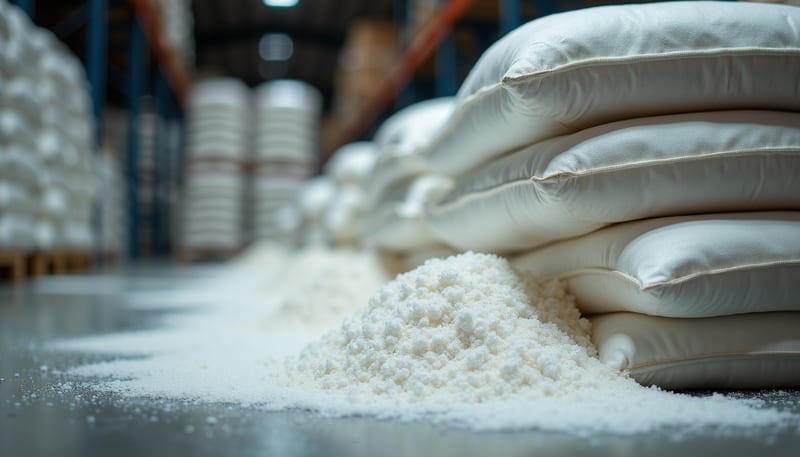
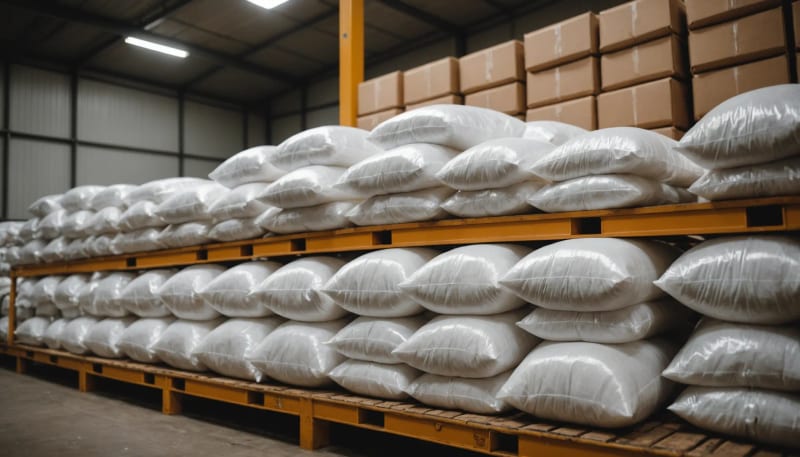
Sugar bags ready for export in warehouse
Benefits of Partnering with Brazilian Sugar Suppliers
Stated without superlatives, the real advantages of Brazilian origin are:
- Range. The whole ICUMSA scale from one origin, so a buyer can move grade without changing country.
- Season length. Two crop calendars, so the aggregate shipping window is longer than most single origins.
- Responsive supply. The sugar–ethanol switch means volume follows price rather than being fixed by planting decisions a year earlier.
- Port capacity. Santos and Paranaguá are built for agricultural bulk and sit near the cane belt.
What Brazilian origin does not automatically give you is the lowest landed cost. Freight and destination duty can erase an origin advantage, which is why the comparison has to be made on one Incoterm, at your port — see what moves a sugar price.
Future Trends in Brazil's Sugar Industry
- Consolidation, which keeps supplier lists going stale.
- Traceability requirements from regulated destination markets — a documentation discipline, not a technology.
- Deeper by-product chains, which make mills less dependent on the sugar line alone.
Maximizing Your Sugar Supply Chain Efficiency
- Contract against the crush, not against your financial year.
- Specify colour and granulation separately, and require the certificate of analysis for your lot.
- Name your inspection agency in the contract, not in conversation.
- Fix the Incoterm before comparing prices.
- Settle storage before the cargo lands — sugar is hygroscopic, and the handling guide covers it.
Expanding Your Business with Brazilian Sugar
Identify your profile, apply the five checks, then ask for a quotation that states the grade, the Incoterm and port, the packaging, the tonnage and its validity.
We are an export trading house in Brazil, not a mill: we source against your written specification and sell FOB Santos or Paranaguá, or CFR/CIF to your port, with the export documentation prepared at origin. Minimum order quantity, Incoterms, lead time, payment terms and packaging are confirmed on quotation; specification figures for your lot are stated on the certificate of analysis.
Tell us which profile you are and what you need, and the quotation will reflect it: enquire.
Recent Posts
The Ultimate Guide to Buy Sugar in Bulk: Smart Tips and Benefits
The Ultimate Guide to Wholesale Sugar Suppliers: How to Choose the Best Partner for Your Business
Unlocking the Potential of Sugar Wholesale: A Comprehensive Guide